


Top 10 Best Forex Trading Tools & Software in 2027



There isn't one piece of software that handles a complete trading operation from start to finish. The most successful forex traders use several tools for each individual task.
Some do economic-event tracking and strategy backtesting. Others do market analysis, position size management, sentiment analysis, correlation studies, performance statistics, or trading journaling.
This article describes 10 best forex trading tools and software in terms of their ability to help the trader perform real trading tasks and not on buzzwords. No matter whether you are looking for software or just a calculator, the task must be matched to the appropriate program.
How We Evaluated These Forex Trading Tools
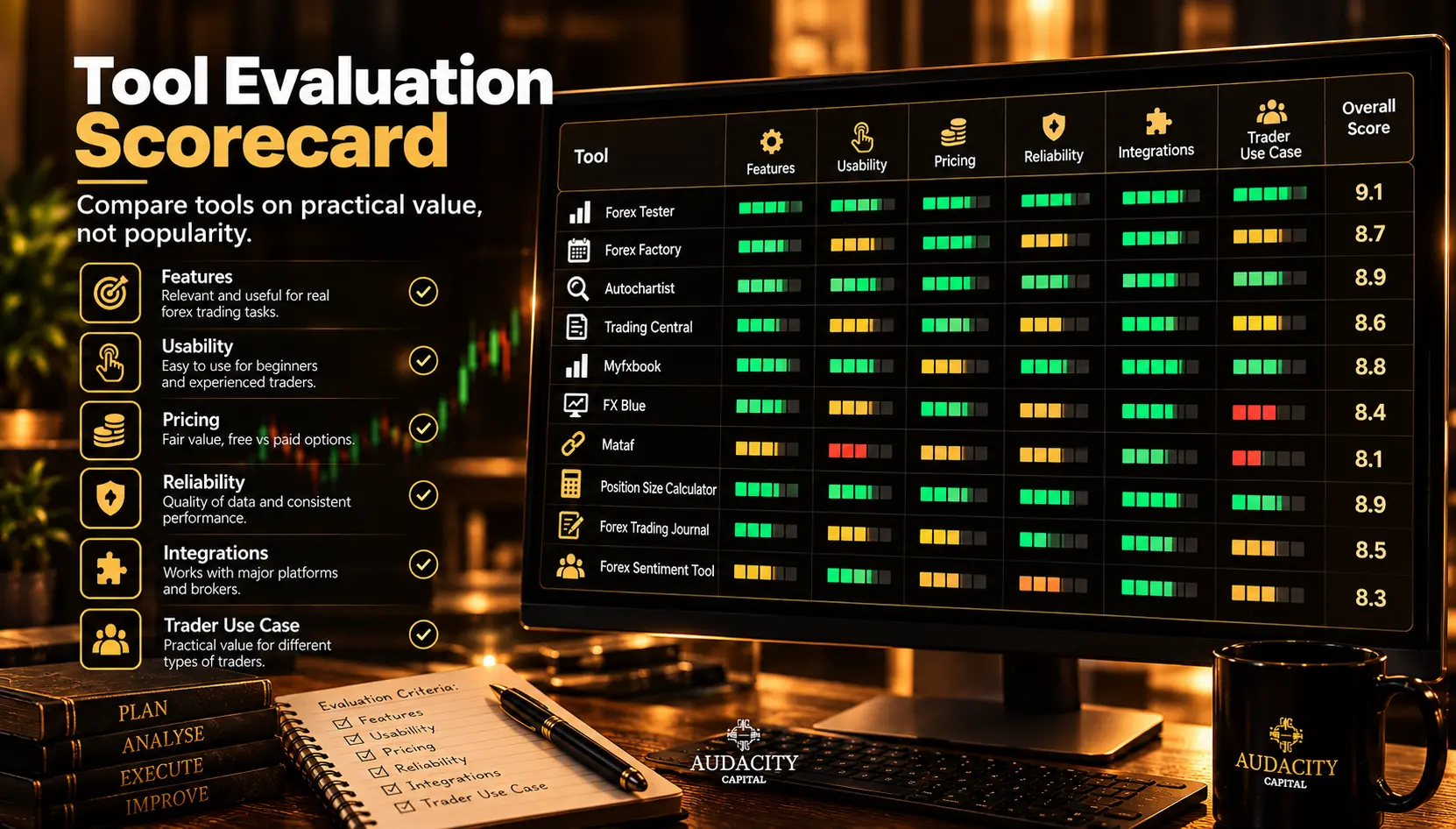
Each tool was evaluated based on the same set of criteria to ensure the evaluation is practical rather than promotional in nature. This included:
- Relevance to forex trading, and not trading in general
- Functionality and usefulness within the context of a trader's work flow
- Quality of data and analysis behind it
- Ease of use for both beginners and experienced users
- Availability for free vs paid
- Platform or broker specific requirements
- Important limitations to know before using it
A tool doesn't score higher just because it has more features. Sometimes a focused calculator is better than a huge bundle that tries to do everything. When a tool offered depth, we considered whether it added clarity or just complexity.
10 Best Forex Trading Tools & Software for 2027
Tool | Best For | Tool Type | Main Purpose |
Forex Tester | Strategy backtesting | Backtesting software | Test strategies based on past data |
Forex Factory | Economic events | Economic calendar | Monitor and analyze planned macroeconomic releases |
Autochartist | Market scanning | Analysis software | Recognize technical patterns and conditions |
Trading Central | Technical research | Research software | Technical analysis and market scenarios |
Myfxbook | Performance analytics | Analytics software | Analytics software Check on account and strategy performance |
FX Blue | Forex analytics | Analytics toolkit | Interpret accounts, currencies and market information |
Mataf | Correlation and volatility | Forex analysis tools | Study currency relationships and risk |
Position Size Calculator | Risk planning | Forex calculator | Determine position size based on risk inputs |
Forex Trading Journal | Performance review | Journaling software | Track trades, mistakes and strategies |
Forex Sentiment Tool | Market positioning | Sentiment analysis | Analyze long/short positioning |
1. Forex Tester: Best for Forex Strategy Backtesting
Forex Tester allows traders to simulate and backtest forex strategies on historical forex markets prior to committing to them live.
Traders will be able to test their strategy entries and exits, apply historical data to various timeframes, and evaluate various metrics including the win ratio, average profit, and drawdown.
The application allows risk-management testing, including the effect of using any stops or position sizing techniques. A demo version of the product provides only partial access, while advanced versions provide full features.
Traders frequently use it to validate ideas before risking money.
One thing about it is important to consider: Past performance does not indicate future performance. Be aware of the signs of overfitting, unrealistic spreads, slippage and shifting market conditions that can impact a clean backtest appearance.
2. Forex Factory: Best for Tracking Economic Events
Forex Factory is an economic calendar that provides information about upcoming releases, their currencies, and their significance level.
You can find forecasts, past and current figures, and central bank releases such as rate decisions from the tool. Time-zone settings enable you to coordinate releases according to your trading time slots.
Important announcements, such as inflation or employment data releases, might lead to dramatic changes in forex markets. Thus, knowing the dates when those announcements are released is crucial.
The most significant disadvantage of using a calendar is its simplicity, meaning that the calendar displays the schedule, not how the currencies will react.
3. Autochartist: Best for Automated Forex Market Scanning
Autochartist scans various markets and identifies technical patterns, price levels, and market conditions without the need for manually looking through each individual chart.
The software can generate alerts if a particular pattern emerges or a price level appears. Another important feature of Autochartist is that it is often integrated with brokers and other providers instead of being a stand-alone software package.
If you are monitoring several currency pairs, then such scanning will save you a lot of time and allow you to focus on those setups which fit your requirements.
The main issue here is that detecting a pattern does not necessarily mean that the trade will make a profit. Autochartist only identify conditions worth analysis. It is not a certain provider of signals, and each set of flags requires your own judgment.
4. Trading Central: Best for Technical Market Research
Trading Central provides technical analysis that traders supplement with their own research. It includes key price points and presents possible market scenarios.
The other important aspect is that it utilizes standard technical indicators and performs multi-timeframe analysis based on the inputs from an analyst. The benefit is that you get a second opinion to consider in addition to your personal one.
This tool is most effective when used as a layer that can confirm or deny the conclusions drawn from your own charts. There are two important points to consider.
First, access may be provided by a broker or financial institution rather than a subscription. Second, Trading Central is a research service and not a broker or trading platform. Therefore, it informs decisions rather than executing them.
5. Myfxbook: Best for Forex Performance Analytics
Myfxbook converts trading history into understandable performance analytics. The service breaks down account statistics, drawdown, profits/losses, currency performance, and trade history.
Moreover, holding period analysis and strategy performance can be observed via charts where trends become visible.
The key point is that the analysis of one’s own trading history helps to identify successful setups and sessions that may not have been noticed without such a tool.
The biggest constraint is data-dependent: what you can analyze is only as good as the data that goes into it. Incomplete and inaccurate account data leads to inaccurate conclusions, so clean and fully synced data is important.
6. FX Blue: Best All-Round Forex Analytics Toolkit
FX Blue combines multiple forex applications in one suite as opposed to solving a single problem. Account analysis, currency strength, correlations, market sentiment, heat maps, market scanners, calculators, and trade statistics all fall under its purview.
The variety is what makes it interesting. In place of jumping from calculators to correlations and sentiment pages, you can perform most of your routine using one application.
Those traders interested in using one app for their analytical needs usually appreciate it. The downside is complexity.
It is difficult for new traders to use FX Blue compared to calculators and even economic calendars when the latter have fewer functions.
With so many functions in one interface, FX Blue becomes more complicated than a calculator or an economic calendar. Therefore, some new traders might prefer starting with fewer features.
7. Mataf Forex Tools: Best for Correlation and Volatility Analysis
Mataf provides a package of forex tools for analysis of currency correlation and volatility. It includes information about movement of pairs, volatility measures, currency indexes, currency strength, pip values, and sizing positions.
Information about correlation of currencies can be important for investors who have positions on multiple currency pairs.
Independent-looking trades might actually have some overlapping risk; therefore, this can help you understand whether you are doubling your risks without being aware of that.
The main disadvantage of using currency correlations is the fact that they are not constant. Depending on the market environment, the correlation might change its value; therefore, the figures should be used only as an illustration.
8. Position Size Calculator: Best for Forex Risk Planning
A position-size calculator helps answer one question: what size should this trade have? This tool requires your account balance, selected risk level, stop-loss level, currency pair, and pip value. Based on that information, it provides you with the position size.
It is covered well by some free calculators, such as EarnForex or Myfxbook. You can use it each time you enter a trade to make sure the risk level is consistent and the sizing process is precise.
It must be noted here that a calculator itself does not decide the level of risk you should take; it merely calculates position size according to the numbers you input. Therefore, the quality of the output depends entirely on sensible inputs.
9. Forex Trading Journal: Best for Reviewing Trading Performance
A forex trading journal is where the element of discipline shines through. Software such as Edgewonk, TraderSync, or any forex trading journal can be used to document your trades, annotate the setups, attach images, and capture your reasons for entering and exiting the trade.
Eventually, you will notice patterns of wins and losses as well as repeated mistakes. In addition, you will find it useful in comparing different strategies and pinpointing habits that may otherwise slip your mind.
The drawback here is rather straightforward yet definitive: a journal can only provide value if the trades are documented and assessed systematically. A deserted journal is useless, so the process is more important than the tool itself.
10. Forex Sentiment Tool: Best for Tracking Market Positioning
Sentiment indicators give you an idea about positioning in the broader group.
There are different choices available such as Myfxbook Community Outlook, FX Blue sentiment, and broker sentiment charts.
These indicators give the percentage of traders who are long or short and how the positioning has changed over time and by sentiment per currency pair.
It provides you with additional information about the market, i.e., the positioning of other participants in the market and not only about the price. Some traders use heavy one-sided positioning as context for their own analysis.
This is the clear drawback of the tool: sentiment is not the indicator for buy/sell signals. Crowded positioning can persist or unwind, so it belongs alongside your analysis, not in place of it.
What Are Forex Trading Tools and Software?
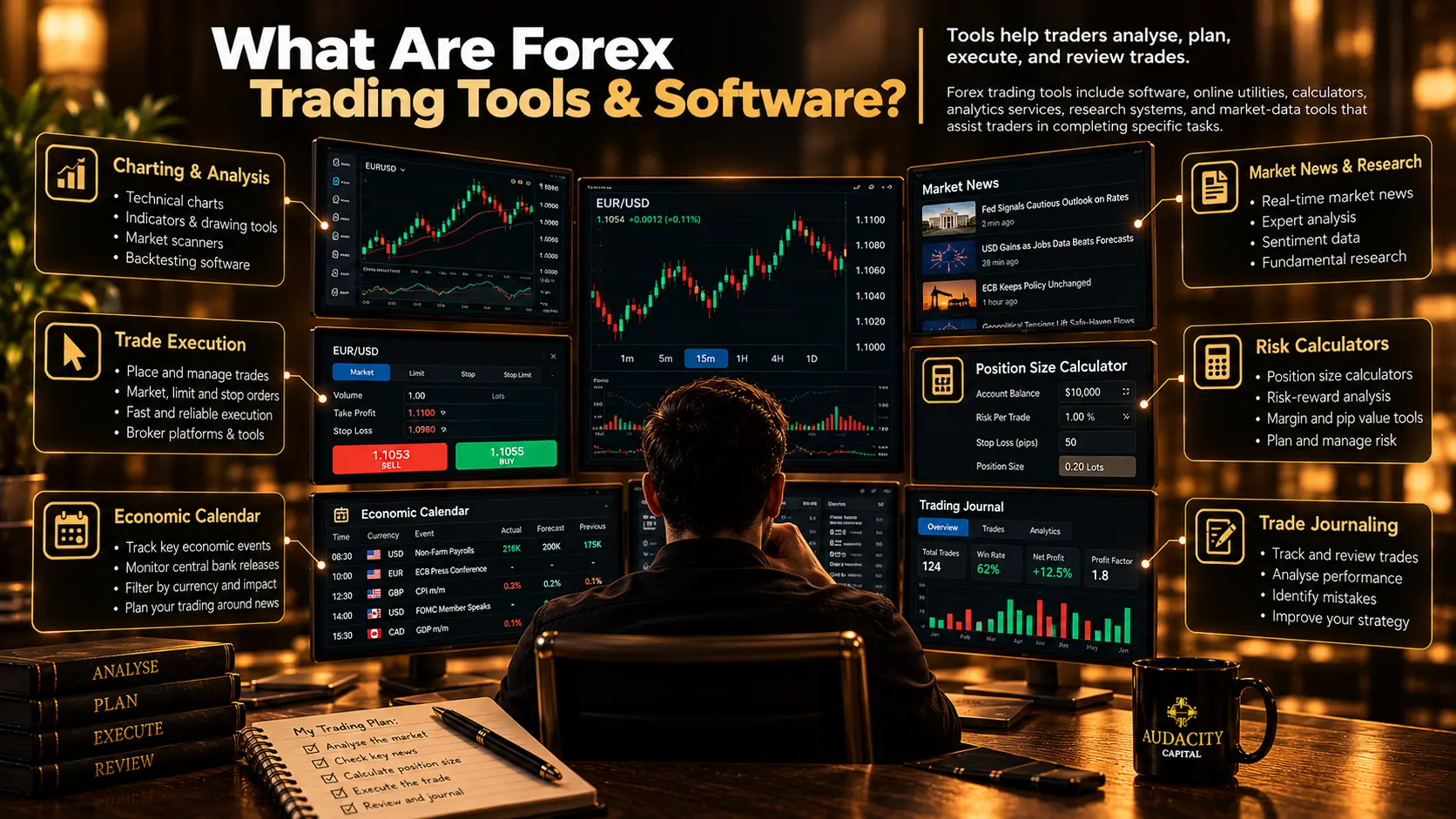
Forex trading tools include software, online utilities, calculators, analytics services, research systems, and market-data tools that can assist the trader in completing particular tasks.
There is quite a broad scope here: Backtesting software, economic calendars, market scanners, sentiment analysis, risk calculators, correlation tools, trading journals and performance analysis.
There is no doubt that it is useful to make some separation between these two concepts.
Forex trading software usually carries out more complicated tasks or combines several functions in one package. For example, a backtesting system or an analytics package that uses a variety of data sources.
Forex trading tools will typically solve certain problems. For instance, it can help with position sizing or provide information on economic events happening today. Both of these are important.
The software deals with complexity, while tools handle precision, and both of them are used together in practice.
Benefits of Using Forex Trading Tools
Used well, these tools sharpen specific parts of your process.
Better risk calculations.
Position-size, volatility, and correlation tools help you understand your true exposure before entering a position, so you size trades deliberately rather than by feel.
Faster market research.
Economic calendars, scanners, and research services organise information that would otherwise mean checking several sources, giving you more time to decide and less time collecting data.
Strategy testing.
Backtesting software lets you evaluate trading ideas against historical market conditions before risking capital, which encourages a tested approach over a hopeful one.
Better performance analysis.
Trading journals and account analytics help you identify repeated mistakes, stronger setups, weak trading sessions, and drawdown patterns you might not notice otherwise.
Less repetitive work.
Calculators, scanners, and automated analytics reduce manual effort and free up attention for the decisions that genuinely require it.
One point stays constant across all of them. Tools support your decision-making. They do not replace trader judgment, and the discipline behind how you use them still decides the outcome.

Choose Your Trading platform With Audacity Capital
Access the Trading PlatformFree vs Paid Forex Trading Tools
There are a lot of good free forex trading tools out there, and some traders have built up a decent strategy while using nothing but free software.
The free or freemium software includes Forex Factory, Myfxbook, FX Blue, Mataf, and almost all position-size calculators. All of these systems will help you in all of the essential tasks of event tracking, analysis, correlation, and risk management.
The paid version of the above-mentioned services usually offers additional details instead of completely new functionality.
Free Tools May Be Enough For | Paid Tools May Add |
Economic calendars | Advanced backtesting |
Position sizing | Deeper historical data |
Basic sentiment | Automated scanning |
Correlation analysis | Advanced analytics |
Basic performance tracking | More detailed journaling |
One thing you must keep in mind that paying for software does not guarantee success. Upgrade the software only when the limitation in the free version affects your work process, not because it has fewer features than the paid software.
How to Choose the Best Forex Trading Tools
Begin by understanding the problem you want to solve: Do you need backtesting, risk analysis, monitoring of economic-events, sentiment analysis, data analysis, or trading journal?
First stating the problem ensures that you will not accumulate tools that you will never use.
Then assess the quality of data provided by the tools: assess how far in history you can go, how fresh the data is, what number of currencies is supported, and whether it is reliable. Weak or stale data undermines even a well-designed tool.
Consider compatibility next. Some tools need an API link, MetaTrader integration, connected account or import of trades. It would help to look into their compatibility with your existing environment.
Think about comparing free vs paid features honestly. Consider trial periods, subscription fees, restrictions on data usage and feature limitations. Decide if a paid version solves your problem.
Consider the ease of use of the tool. A tool with many functions does not become better if it makes your workflow less efficient.
Finally, consider security. Before linking any external application, it is important to know what you give: API permission, account credentials, read-only access, etc. It is better to prefer read-only access to your account and not to give too many permissions.
Limitations of Forex Trading Tools
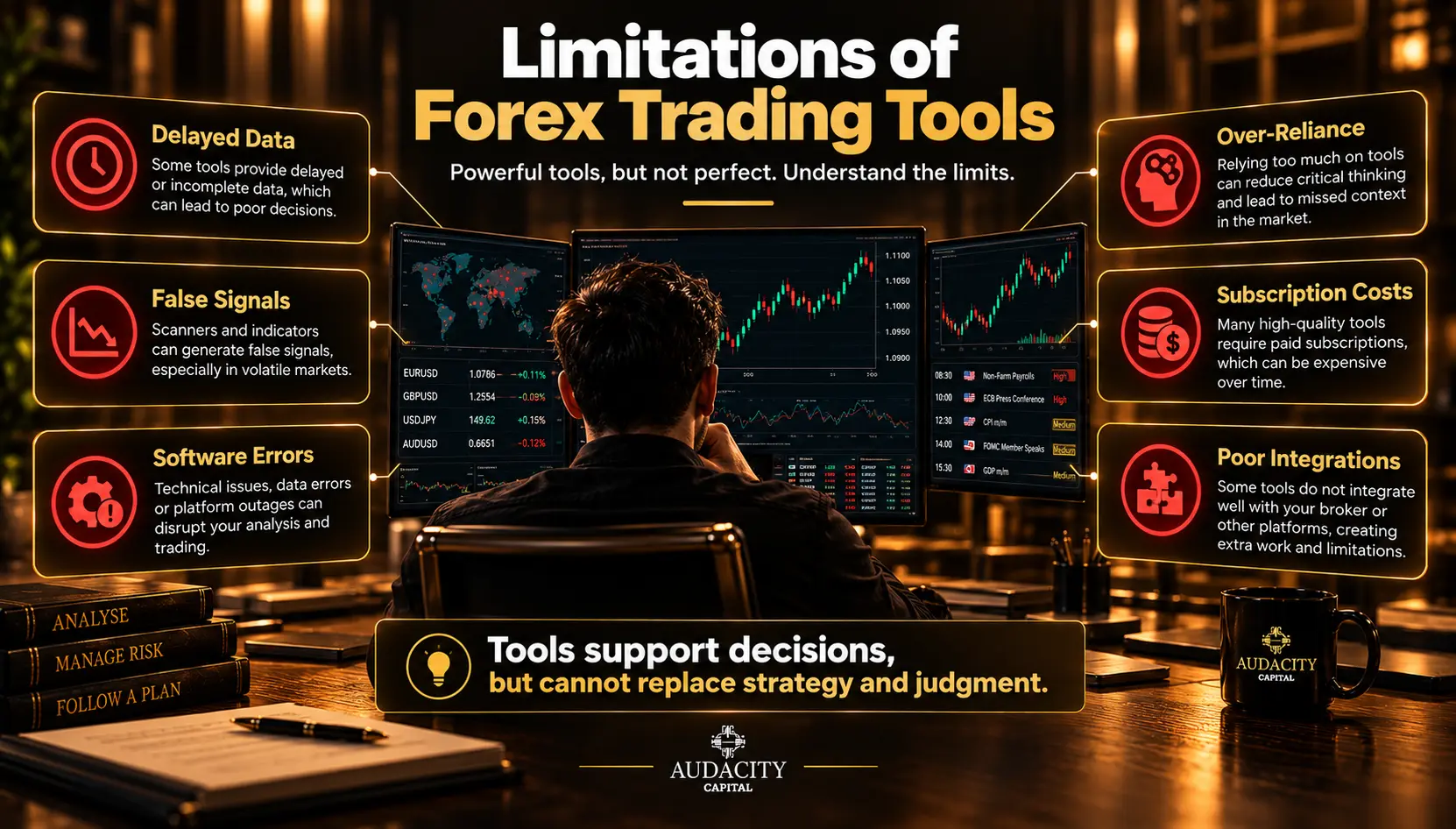
Tools help, but they come with real boundaries worth respecting.
Tools cannot predict markets with certainty.
Scanners, calendars, sentiment tools, and analytics organise information and highlight conditions, but none of them can guarantee future price movements.
Backtesting can be misleading.
Results are affected by overfitting, poor historical data, unrealistic trading costs, and the simple fact that market conditions change. A perfect backtest is often a warning sign, not a green light.
Sentiment and correlation change.
Trader positioning shifts, and historical currency relationships are not fixed. Treating either as permanent sets you up for surprises.
Analytics depend on good data.
Missing or incorrectly imported trades distort performance results, which can lead you to trust the wrong conclusions about your own trading.
Too many tools can create analysis paralysis.
Running several scanners, indicators, calculators, and research feeds at once often produces conflicting signals that slow you down instead of helping.
The practical answer is restraint. Use a small number of tools with clearly defined purposes, and trust your process over the volume of information on your screen.
Conclusion
Not all of the ten tools are needed to be a good trader. An optimal combination of the forex trading tools should comprise one economic calendar, one risk calculator, one market-analysis or scanning software, one backtesting application, and one journaling or analytics tool.
It will cover all stages from planning to reviewing without being too complicated. The best forex trading tools are those which have a clear role in your trading process. If a tool has no defined purpose in your process, it is adding noise, not value.
Forex Trading Tools In Depth
Frequently Asked Questions
There is no single winner, because the right tool depends on the job. For economic events, Forex Factory stands out. For risk planning, a solid position-size calculator does the work.
For backtesting, Forex Tester is a common choice, while Myfxbook and FX Blue cover analytics. Pick by task, not by reputation.
It depends on what you need it to do. If you want to test strategies, the best forex trading software for you is a backtesting tool.
If you need analytics, a platform like Myfxbook fits better, and for research, a service such as Trading Central suits the task. Match the software to the specific job rather than searching for one product that does everything.
Several strong free or freemium options were covered above, including Forex Factory for economic events, Myfxbook for performance analytics, FX Blue for a broad toolkit, Mataf for correlation and volatility, and free position-size calculators for risk planning. Together they can support a complete routine at no cost.
Forex Tester is a widely used choice for strategy backtesting, letting you test ideas against historical data with detailed statistics and risk-management testing.
Just remember that historical results do not guarantee future outcomes, and watch for overfitting and unrealistic costs.
No. Software can analyse data, calculate risk, identify market conditions, and organise information efficiently, but it cannot guarantee future market direction.
Every tool informs your decisions. None of them removes the uncertainty that comes with trading, and disciplined judgment still decides the result.

Ready to apply disciplined risk to crypto? Explore Audacity Capital's new crypto instruments and bring your trading strategy.
Learn MoreNewsletter
Join our newsletter to stay up to date on features and releases.
Join Our Social & Community

Start Your Journey Today With Our Free Trial
Proudly showcase your skills and accomplishments through certificates and get recognition for your hard work and dedication from potential investors and peers.
Free TrialRelated Articles
What Is the Slow Stochastic Oscillator? Formula, Signals and Strategies
Learn how the Slow Stochastic Oscillator works, understand its formula and signals, and explore trading strategies and risk management.

Stochastic Oscillator vs RSI: How They Differ and How to Use Them
Compare RSI and the Stochastic Oscillator, understand their signals, and choose the right indicator for your trading strategy.
Bearish RSI Divergence: How to Spot It, Confirm It and Trade It
Learn how to identify bearish RSI divergence, confirm reversal signals, plan entries and exits, and manage risk with practical forex trading examples.
Sortino Ratio in Trading: How It Measures Downside Risk
Learn what the Sortino Ratio means, how to calculate it using downside deviation, and how traders use it to compare risk-adjusted performance.