


Forex Trading vs Stock Trading: What’s the Difference?


Choosing between forex trading and stock trading depends on your financial goals, trading experience, available time, and attitude towards risk. Both markets offer opportunities to trade price movements, but they work differently. They also respond to different economic and business factors.
Forex trading involves buying and selling currencies, while stock trading involves buying and selling shares of publicly listed companies. Forex traders often focus on exchange rates, interest rates, and economic data. Stock traders may focus on company earnings, business performance, industry trends, and broader market conditions.
So, which market is better for beginners? Is forex cheaper to trade than stock? And how do trading hours, leverage, liquidity, and volatility compare?
In this guide, we explain the key differences between forex trading and stock trading to help you understand how each market works and decide which may suit your trading approach.
Forex Trading vs Stock Trading: Key Differences at a Glance
Forex and stock markets differ in several important ways. The table below summarises the main factors to consider before choosing between them.
Feature | Forex Trading | Stock Trading |
|---|---|---|
What you trade | Currency pairs, such as EUR/USD | Shares of publicly listed companies |
Main price drivers | Interest rates, inflation, employment data, economic growth, and geopolitical events | Company earnings, financial performance, industry developments, and economic conditions |
Trading hours | Generally available 24 hours a day, five days a week | Depend on the stock exchange and the instrument traded |
Liquidity | Very high in major currency pairs | Varies by stock and exchange |
Volatility | Depends on the currency pair and market conditions | Depends on the stock, sector, and market conditions |
Leverage | Available through certain brokers and products, subject to applicable rules | Depends on the market, broker, account, and instrument |
Trading costs | Spreads, commissions, overnight financing, and other applicable charges | Commissions, bid-ask spreads, exchange fees, and other applicable charges |
What influences decisions | Macroeconomic data and relative currency strength | Company fundamentals, market sentiment, and economic conditions |
Ownership | Trading a currency pair does not generally mean owning the underlying currencies in a traditional investment account | Buying shares generally represents ownership in the company |
Neither market is automatically more profitable or safer. The outcome depends on the instrument, trading strategy, costs, market conditions, and risk management.
What Is Forex Trading?
Forex trading, also known as foreign exchange trading, involves buying one currency while selling another. Currencies are quoted in pairs, and traders attempt to benefit from changes in their exchange rates.
For example, EUR/USD represents the value of the euro against the US dollar. If a trader expects the euro to strengthen against the dollar, they may buy EUR/USD. If they expect the euro to weaken, they may sell the pair.
Currency prices can change in response to several factors, including:
- Central bank interest rate decisions
- Inflation and employment reports
- Economic growth and GDP figures
- Geopolitical developments
- Investor sentiment and demand for different currencies
The forex market operates globally, with trading generally available around the clock from Monday to Friday. However, liquidity, spreads, and volatility can vary across trading sessions and currency pairs.
Check detailed guide about Forex trading
Advantages of Forex Trading
1. Flexible trading hours
Forex traders can access the market across Asian, European, and North American trading sessions. This can be useful for people who need to fit trading around other commitments.
2. High liquidity in major currency pairs
Pairs such as EUR/USD and USD/JPY generally have substantial trading activity. High liquidity can help traders enter and exit positions more easily, although it does not eliminate slippage or guarantee favourable execution.
3. Opportunities in rising and falling markets
Depending on the trading product and broker, traders can take long or short positions to express a view on currency movements.
4. Access to leverage
Some forex products allow traders to control positions larger than their account balance. This can increase the potential return on the capital committed, but it also magnifies losses and can lead to rapid account depletion.
Check the guide What Is Leverage in Forex Trading
5. A wide range of trading strategies
Forex traders may use trend-following, breakout, support and resistance, momentum, or fundamental analysis strategies.
Read more about 10 Best Prop Trading Strategies for Consistent Profits
Disadvantages of Forex Trading
1. Leverage increases risk
A small price movement can produce a substantial gain or loss when leverage is used. Traders need to understand margin requirements and the possibility of losing more than expected, depending on the product and account protections.
2. Economic news can cause sharp price movements
Interest rate decisions, inflation reports, and unexpected geopolitical events can lead to sudden changes in currency prices.
3. Overnight costs may apply
Positions held overnight may incur swap charges, financing costs, or other fees, depending on the broker and instrument.
4. The market requires continuous learning
Understanding how economic data, central bank policies, and global developments affect currency pairs takes time and practice.
What Is Stock Trading?
Stock trading involves buying and selling shares of publicly listed companies. When investors purchase shares, they generally acquire an ownership interest in the relevant company. Traders may seek to profit from changes in share prices, while longer-term investors may also consider dividends and business growth.
For example, a trader may buy shares in a technology company after analysing its earnings, growth prospects, and market position. If the share price rises, the trader may sell at a profit. If the price falls, the trader may incur a loss.
Stock prices are influenced by several factors, including:
- Company earnings and revenue growth
- Business strategy and management decisions
- Industry competition and market trends
- Interest rates and inflation
- Investor expectations and broader economic conditions
Stock trading can involve individual shares, exchange-traded funds (ETFs), or derivatives linked to stock prices. These instruments have different characteristics, costs, and risks.
Advantages of Stock Trading
1. Access to individual companies and industries
Traders can focus on specific businesses, such as technology, healthcare, energy, or financial services. This allows them to analyse company-specific developments as well as wider market trends.
2. Access to company information
Listed companies publish financial statements, earnings reports, and other disclosures that traders and investors can use to assess business performance.
3. Potential for long-term investment growth
Investors who hold shares over longer periods may benefit from business growth, rising share prices, and dividends where companies pay them. These outcomes are not guaranteed, and share prices can decline substantially.
4. A broad selection of instruments
Stock markets offer access to companies across different industries, regions, and market capitalisations. The range of available shares varies by exchange and broker.
Disadvantages of Stock Trading
1. Company-specific risks
A company may experience falling sales, legal problems, management issues, or unexpected losses. These developments can negatively affect its share price.
2. Trading hours depend on the exchange
Most stock exchanges operate during defined sessions. Extended-hours trading may be available for some shares, but liquidity and execution conditions can differ from regular market hours.
3. Costs vary between instruments and brokers
Commissions, spreads, exchange fees, currency conversion charges, and other costs may affect trading results.
4. Prices can change sharply
Stocks are not necessarily less volatile than forex. Individual shares can experience substantial price swings following earnings announcements, company news, or changes in market sentiment.
Forex Trading vs Stocks Trading: Six Important Differences
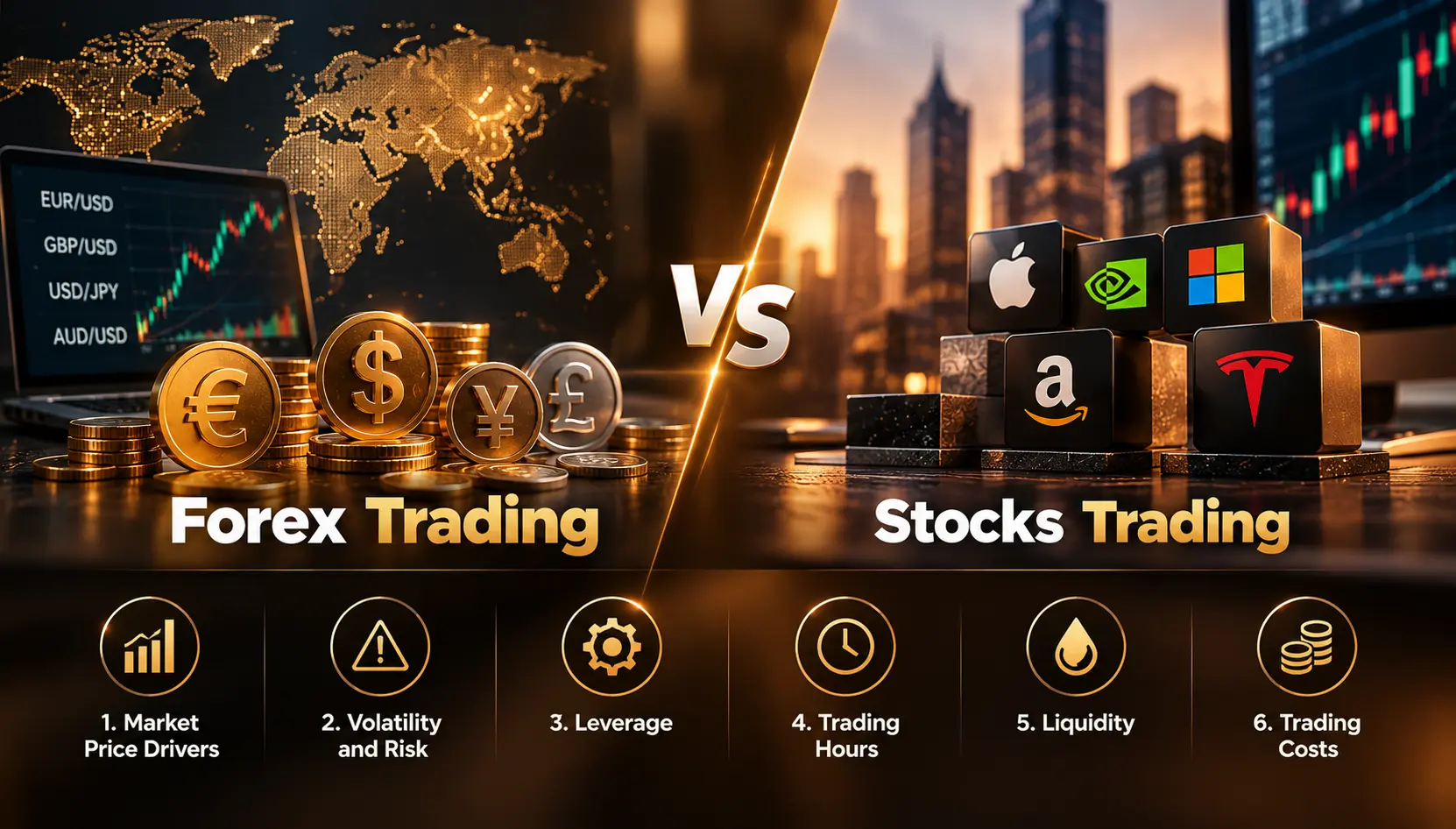
Understanding the practical differences between these markets can help you decide which one is more compatible with your goals and trading style.
1. What Moves Market Prices?
One of the biggest differences between forex trading and stock trading is the information traders use to analyse prices.
Forex market drivers
Forex prices reflect the relative value of one currency against another. Traders often examine economic data and monetary policy in both countries represented by a currency pair.
For example, if the US Federal Reserve signals that interest rates may remain higher than expected, the US dollar could strengthen against other currencies. However, the actual reaction depends on what markets have already anticipated and on other developments.
Important forex indicators include:
- Interest rate decisions
- Inflation reports
- Employment figures
- GDP growth
- Central bank statements
- Geopolitical developments
Stock market drivers
Stock prices are influenced by both company-specific information and broader economic conditions.
For example, a company reporting stronger-than-expected earnings may attract buyers. However, its share price could still fall if investors expected even better results or if the company lowers its future outlook.
Stock traders commonly examine:
- Revenue and earnings
- Earnings forecasts
- Company debt and cash flow
- Industry developments
- Management announcements
- Interest rates and economic growth
Which market is easier to analyse?
Neither market is universally easier. Forex analysis often requires understanding the relationship between economies and currencies, while stock analysis may involve researching individual businesses and industries. Both require practice and a clear decision-making process.
2. Volatility and Risk
Volatility measures how much an asset's price fluctuates over a period. It is an important consideration when comparing forex and stock trading, but neither market is consistently more volatile in every situation.
Major currency pairs can experience relatively modest movements during quiet sessions and sharp moves around important economic announcements. Individual stocks may experience significant price changes after earnings reports, company news, or unexpected events.
The risk of a trade also depends on position size, leverage, stop-loss placement, liquidity, and the possibility of slippage or price gaps.
For example, a trader using excessive leverage may face a substantial loss following a relatively small market movement. Another trader with a smaller position and a defined risk limit may experience a more manageable loss under similar market conditions.
Before trading either market, consider:
- How much you can afford to lose
- How much capital is exposed to each position
- Whether leverage is being used
- How the instrument behaves during major news events
- Whether gaps or reduced liquidity could affect execution
Volatility creates opportunities for price movement, but it does not guarantee profitable trades.
3. Leverage: How Does It Affect Forex and Stock Trading?
Leverage allows traders to control a position larger than the capital they commit. It is available for certain forex and stock-related products, but the amount permitted varies by broker, jurisdiction, and instrument.
Suppose a trader opens a position with a notional value of £10,000 using £1,000 of their own margin. This represents effective leverage of 10:1.
If the position moves favourably by 1%, the gross gain would be £100. If it moves unfavourably by 1%, the gross loss would also be £100, before costs.
That loss equals 10% of the £1,000 margin committed, even though the underlying position moved by only 1%.
This illustrates why leverage must be managed carefully.
Forex trading commonly offers leverage through products such as rolling spot forex or contracts for difference (CFDs), subject to applicable rules. Stock-related leverage may be available through margin accounts, CFDs, or other derivatives.
Buying shares outright without borrowing is different: the investor is generally exposed to the share-price movement without the additional leverage created by a margin loan.
The key point: Higher leverage does not make a strategy better. It increases exposure and can magnify losses just as quickly as gains.
4. Trading Hours: When Can You Trade?
Forex and stock markets follow different schedules.
Forex trading hours
The global forex market generally operates 24 hours a day, five days a week. Trading activity moves between major financial centres, including Sydney, Tokyo, London, and New York.
Market conditions can vary depending on the session. Some currency pairs may be more active when the relevant financial centres overlap, although activity changes with economic releases, holidays, and market conditions.
Stock trading hours
Stock exchange hours depend on the exchange and the listed instrument. For example, regular trading hours for the New York Stock Exchange are generally 9:30 a.m. to 4:00 p.m. Eastern Time on trading days, excluding applicable holidays and special schedules.
Some brokers provide access to pre-market or after-hours trading for eligible stocks. These sessions may have lower liquidity, wider spreads, and greater price fluctuations.
Which is more convenient?
Forex may suit traders who need flexibility across different time zones. Stock trading may be more convenient for people who prefer to focus on defined exchange sessions. The best choice depends on your schedule and the instruments you intend to trade.
5. Liquidity: How Easily Can You Enter and Exit a Trade?
Liquidity refers to how readily an asset can be bought or sold without causing a substantial change in its price.
The forex market is one of the largest financial markets globally, and major currency pairs generally have high liquidity. However, less-traded currency pairs may have wider spreads and lower liquidity.
Stock liquidity varies considerably. Shares in large, actively traded companies may have narrow spreads and substantial trading volume, while smaller or less frequently traded stocks may be harder to buy or sell at a desired price.
Liquidity can also change during major news events or periods of market stress.
When comparing trading costs, consider the bid-ask spread, commissions, slippage, and the size of the position you plan to trade. A market with high overall trading volume does not guarantee favourable execution for every instrument or trade.
6. Trading Costs: Is Forex Cheaper Than Stocks?
The cost of trading depends on the broker, instrument, position size, trading frequency, and how long a position remains open.
Forex trading costs may include:
- Bid-ask spreads
- Trading commissions
- Overnight financing or swap charges
- Currency conversion fees, where applicable
Stock trading costs may include:
- Bid-ask spreads
- Broker commissions
- Exchange or regulatory fees, where applicable
- Currency conversion charges for international shares
- Margin interest or financing costs, where applicable
A trader who opens and closes positions frequently may pay significant costs over time, even when individual transaction charges appear small.
Holding a leveraged position overnight may also create financing costs that affect the final result.
Rather than assuming that forex or stocks are always cheaper, compare the total cost of trading the specific instruments you plan to use. Review the broker's fee schedule and consider how the costs affect your strategy.
Forex vs Stock: Which Market Is Better for Beginners?
There is no single market that is best for every beginner. The right choice depends on what you want to learn, how much time you have, and how you intend to manage risk.
Forex may suit you if:
- You are interested in currencies and global economic developments.
- You want to study the relationship between interest rates, inflation, and exchange rates.
- You prefer a market with trading opportunities across multiple sessions.
- You are willing to learn how spreads, leverage, and overnight financing work.
Stock trading may suit you if:
- You are interested in individual companies and their financial performance.
- You want to study earnings reports, business models, and industry trends.
- You prefer to focus on specific companies or sectors.
- You are considering longer-term share ownership as well as shorter-term trading.
These are starting points, not strict rules. Forex can involve longer-term positions, and stocks can be traded over very short periods. Your strategy, instrument, and risk controls matter more than the market label alone.
How should beginners get started?
Regardless of the market you choose, begin by learning how the instrument works and what can cause its price to change.
A sensible starting process includes:
- Learn the basic terminology, order types, and trading costs.
- Choose a reputable, appropriately regulated provider.
- Practise with a demo account before risking real money.
- Develop a written trading plan with clear entry and exit conditions.
- Learn position sizing and how to set an appropriate risk limit.
- Keep records of your trades and review your decisions regularly.
A demo account can help you practise, but simulated results do not guarantee that you will achieve the same results in live markets.
Can You Trade Forex or Stock Without Using Your Own Trading Capital?
Some traders explore proprietary trading firms, commonly known as prop firms, as an alternative to trading solely with their own capital.
Depending on the firm and programme, traders may be required to complete an evaluation or may have access to a different funding arrangement. They must follow the programme's rules, which may cover profit targets, maximum drawdown, daily loss limits, trading restrictions, and payout eligibility.
A funded trading programme is not the same as receiving unrestricted personal investment capital. Access, account conditions, fees, and payouts depend on the firm's terms. Traders can also lose fees paid for an evaluation or fail to qualify for a payout.
Audacity Capital offers funded trading programmes for traders interested in forex and related markets. Before selecting a programme, review the current eligibility requirements, trading rules, costs, and payout conditions to understand whether it fits your approach.
If you are considering a prop firm, ask the following questions:
- What instruments can I trade?
- Is an evaluation required?
- What are the profit target and drawdown limits?
- Are there restrictions on holding positions overnight or over weekends?
- What trading strategies and news-trading activities are permitted?
- What conditions must be met to receive a payout?
- What fees apply, and what happens if I breach a rule?
Read the current programme terms carefully before making a decision.
Common Mistakes to Avoid When Choosing Between Forex and Stock
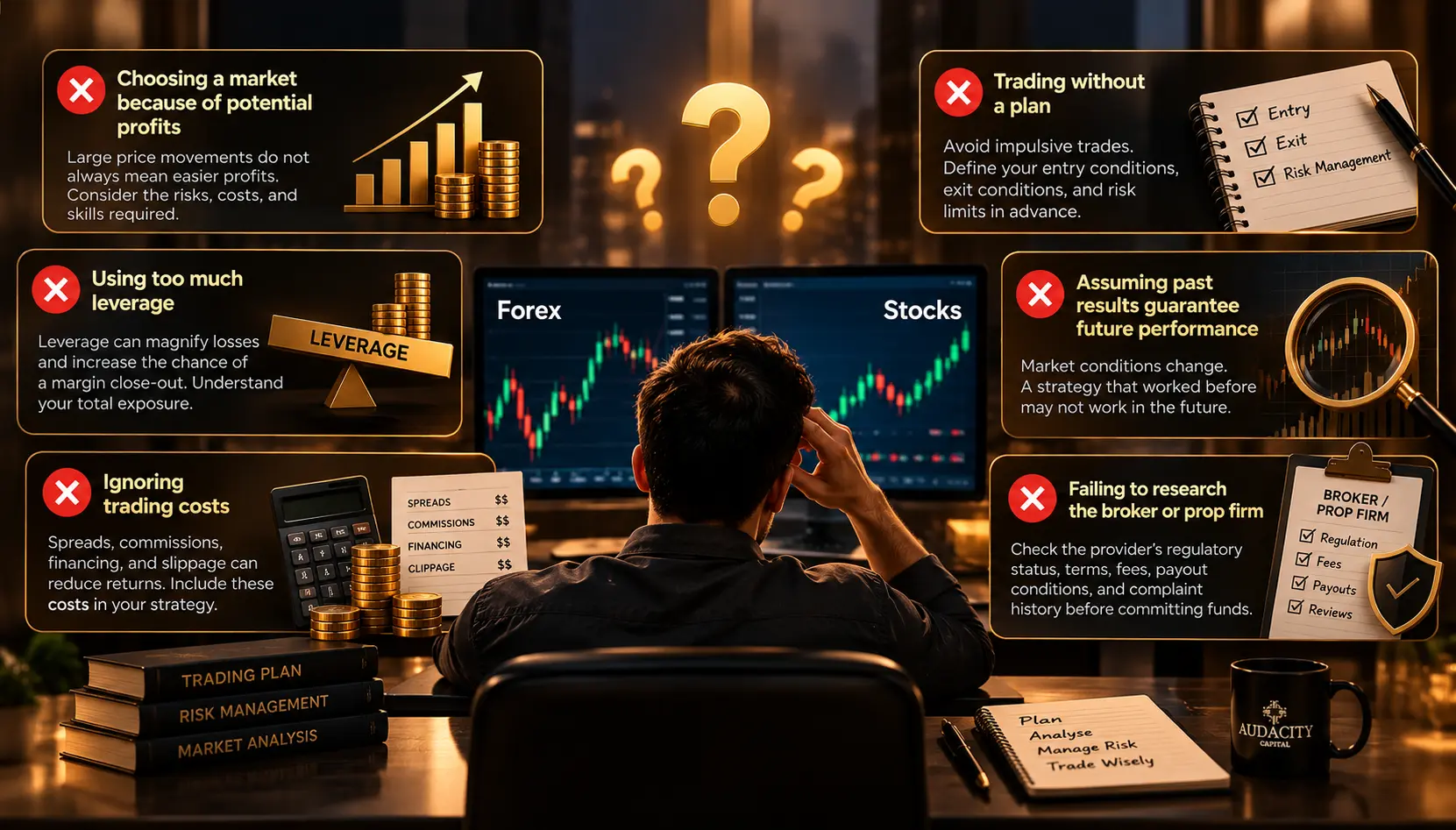
Beginners can make avoidable mistakes when selecting a market or starting to trade. Understanding these risks can help you make more informed decisions.
Choosing a market because of potential profits
A market's potential for large price movements does not mean it is easier to profit from. Consider the risks, costs, and skills required before choosing an instrument.
Using too much leverage
Leverage can magnify losses and increase the chance of a margin close-out. Understand your total exposure and avoid taking positions that are too large for your risk limits.
Ignoring trading costs
Spreads, commissions, financing, and slippage can reduce returns. Include these costs when evaluating a strategy.
Trading without a plan
Entering trades based on impulse or fear of missing out can lead to inconsistent decisions. Define your entry conditions, exit conditions, and risk limits in advance.
Assuming past results guarantee future performance
Market conditions change. A strategy that worked in one environment may perform poorly in another, so review your approach and avoid treating historical results as a promise of future gains.
Failing to research the broker or prop firm
Check the provider's regulatory status where applicable, terms, fees, withdrawal or payout conditions, and complaint history before committing funds.
Forex Trading vs Stock Trading: Which Should You Choose?
Forex trading and stock trading both offer ways to participate in financial markets, but they require different types of research and expose traders to different risks.
Forex traders typically analyse currency relationships, central bank policies, and macroeconomic data. Stock traders may focus more heavily on company earnings, business performance, and industry developments. Both markets can be volatile, and both require discipline, preparation, and effective risk management.
Before choosing, consider your interests, schedule, experience, trading costs, and ability to withstand losses. Practise before trading with real money, and do not assume that any market or strategy will guarantee profits.
The most suitable market is the one you understand well enough to assess its risks and trade according to a consistent plan.
Guides About Forex For Beginners
- Forex Trading for Beginners
- The Guide About Forex Lot Size and Leverage
- The Best Forex Books for Beginners
- Best Forex Trading App for Beginners
- Leverage vs Margin in Forex Trading
- Forex Trading Strategies for Beginners
- Forex Trading Tax US
- Forex Trading Tax UK
- Best Forex Brokers for Beginners
- Best Leverage for forex
- Is Forex Trading Profitable?
- Prop Trading vs Hedge Funds
- Learn more about our guide How Much Money Do You Need to Start Trading Stocks?
- Learn more about our guide Prop firm for stocks
Check Our Funded Trader Program
Frequently Asked Questions
Neither is automatically better. Forex may appeal to traders interested in currencies and macroeconomic developments, while stock trading may suit people who prefer researching companies and industries. The right choice depends on your goals, experience, costs, and risk tolerance.
Both markets involve risk. Forex trading can carry substantial risk when leverage is used, while individual stocks can experience sharp price declines due to company-specific or broader market events. Risk depends on the instrument, position size, leverage, and trading approach.
It is possible to make profits in either market, but losses are also possible. Results depend on market conditions, execution, trading costs, strategy, and risk management. Neither market guarantees a profit.
Not always. Forex costs may include spreads, commissions, and overnight financing. Stock trading may involve commissions, spreads, exchange fees, and other charges. Compare the total costs for your intended instruments and trading frequency.
That depends on your interests and learning approach. Forex requires an understanding of currency pairs and macroeconomic relationships. Stock trading involves learning about share prices, company performance, and market behaviour. Beginners should focus on learning one market at a time and practising before committing real money.
Yes, subject to your broker's offerings and any applicable programme rules. However, trading multiple markets requires additional research and risk management. Positions across different instruments may also be exposed to related economic events or market risks.
Forex trading generally involves taking positions on exchange-rate movements between currencies. Investing in stocks usually involves purchasing shares that represent ownership in a company, with potential returns from price appreciation and dividends. The distinction can vary when traders use derivatives rather than owning the underlying asset.
No. Forex trading is generally available 24 hours a day, five days a week, while stock trading follows the schedules of individual exchanges. Some stocks also have pre-market and after-hours sessions, depending on the broker and market.
Some proprietary trading firms offer programmes that provide eligible traders with access to trading capital under specific conditions. The process, instruments, risk limits, fees, and payout rules vary by firm. Always review the current terms before joining a programme.
Start with market fundamentals, order types, trading costs, position sizing, and risk management. Practise in a demo environment, develop a trading plan, and learn how relevant economic or company news affects your chosen instruments before risking real money.

Ready to apply disciplined risk to crypto? Explore Audacity Capital's new crypto instruments and bring your trading strategy.
Learn MoreNewsletter
Join our newsletter to stay up to date on features and releases.
Join Our Social & Community

Start Your Journey Today With Our Free Trial
Proudly showcase your skills and accomplishments through certificates and get recognition for your hard work and dedication from potential investors and peers.
Free TrialRelated Articles

10 Best Futures Prop Firms for Swing Trading In 2026
Compare the best futures prop firms for swing trading in 2026 with overnight holding, flexible rules, fast payouts, and funded accounts.


From Demo To Live: When Are You Ready To Go Live?

How To Choose The Right Prop Firm – A Complete Checklist
Learn how to choose the right prop trading company with our expert guide. Compare fees, rules, profit splits, and platforms to trade confidently.
The First 30 Days: What New Traders Should Focus On (And Ignore)