


How to Stop Overthinking and Overreacting in Trading


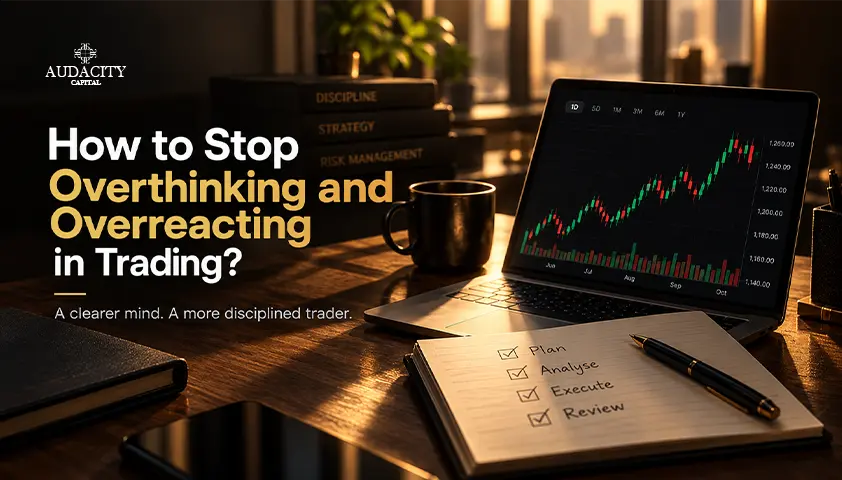
How to stop overthinking in trading? Many traders only notice they were doing emotional trading after the trade has gone. The plan said buy above ₹640; the price touched ₹641, and instead of clicking, they went looking for one more reason, a fourth indicator or a different timeframe. By the time the reason showed up, the price was at ₹652.
If you have been in a similar scenario, by now you know that how to stop overthinking in trading is not a theory question. Overthinking in trading does have one or more answers, but they all have to work in the exact moment of doubt, and not in books or guides.
Both overthinking and overreacting in trading come from one weak spot. One side waits too long for certainty, the other side jumps in quickly once FOMO gets loud. When you look at both, there is no clear stopping point. The solution is not to analyse less. It is to know in advance what you need to see, what you do when you see it, and what makes you walk away. The rest of this guide will cover that and more on emotional trading step by step.
What Does Overthinking Look Like in Trading?
Overthinking isn’t the same as being careful. Careful analysis does matter when money is on the line, but the fifth look at the same evidence rarely changes the answer, and that’s because the questions have stopped giving you anything new. A trader dealing with analysis paralysis in trading will display certain habits that are easy to recognise, and those are the ones that push into emotional trading.
- Opening hourly charts for a trade, say 1-minute, 5-minute, and hourly, but the plan only suits on the 15-minute chart.
- Adding a second momentum indicator because the first one agreed with you too easily.
- Waiting for a “perfect” confirmation until the entry level has gone.
- Dropping a strategy after two or three losses, which is far too few trades to judge anything.
- Replaying last Tuesday’s mistake while the live setup is forming in front of you.
A quick test separates useful analysis from stalling. Ask whether the new piece of information would change your decision. If it wouldn’t, you are looking for comfort and not for data. The financial market never offers certainty, and thus whether the setup meets your written rules will be a better question.
Why Do Traders Overthink and Overreact?
Money gives every decision extra weight. That’s where loss aversion comes in, a term from behavioural economics for the fact that a loss hurts more than an equal gain pleases. Commonly, a run of losing trades leaves you cautious. The trouble starts when the caution becomes a habit of asking for more confirmation, even if the next setup meets each rule you noted down.
What adds up next to emotional trading is decision fatigue. By afternoon, a trader who has been taking small decisions since morning, maybe forty of them, has less patience for the one that actually counts. Too much information makes it worse; charts, news, and group chats keep supplying material, and without a rule for what to consider, you end up comparing reasons when you should be judging the setup.
Now, while this isn’t dramatic in theory, it still feeds emotional trading all the same. Take a hypothetical entry at ₹640 with a stop at ₹634, so the risk is ₹6 a share.
- You hesitate because the entry doesn’t feel safe enough.
- The price runs to ₹652 and the frustration builds.
- You buy at ₹652 because it looks too good to miss, but the stop is still at ₹634.
- Your risk has tripled to ₹18 a share, and a small pullback now pushes you to exit in a hurry.
Hesitation produced the late entry, and the late entry produced the panic. That’s why trading decision-making improves when you fix the first link in this chain.
How to Stop Overthinking in Trading?

Overthinking thrives when rules are unclear. So before the market opens, make sure your rules are sharpened. Anyone asking how to stop overthinking in trading gets more from a one-page checklist than from yet another indicator.
Set Your Trading Conditions Before the Market Opens
Start with a trade thesis, which is a single sentence saying why you expect the trade to work. Something like “Price held ₹1,240 twice this week and volume is rising into it, so I expect a bounce toward ₹1,275.” If you can’t write it in one sentence, you don’t have a setup yet, and that alone settles many debates.
Then attach the numbers. A pre-trade checklist keeps them together.
- The entry trigger, written as a price plus a condition.
- The stop-loss level and the reason it sits there.
- Position size, worked out from the rupee amount you accept losing.
- The exit plan, including a time stop, which closes the trade if nothing has happened after a set period.
- A cooling-off rule after a stop-out, for example, 20 minutes with no new order.
The checklist won’t make you right more often, but it will stop you from inner questions about things you have already settled.
Limit the Information You Use
While more indicators feel safer, they mostly cost you focus. Here is a tip that settles it quickly. Hide one tool for a week, keep a note of any decision it affected and see what the notes say. A tool that never moved a decision is noise, and removing it frees up room to think. Pair a trend filter with a trigger and you have two inputs with separate jobs, which beats a screen of lines repeating each other. Real news is the one thing to keep watching. When an announcement alters what your thesis assumed, go back to the thesis and read it again.
Decide When Your Analysis Is Complete
Where does collecting end and deciding begin? Answer that before the market opens. For most plans, the candle close on your chosen timeframe is the cleanest answer, with data coming in before it and the decision coming after. Some traders keep adding data past that point, and that is how a 10:15 signal turns into a 10:40 entry.
As the candle closes, go down your checklist from the top and tick each item. When every box is ticked, you enter. When one is empty, the answer is no, and nothing more needs saying about that trade. This habit removes a lot of hesitation, because “maybe” is no longer an allowed answer.
Review Your Strategy at the Right Time
Review on a schedule and not on feelings. Friday evening works well, since the week is complete and your emotions have cooled. Go through the journal and tag each trade with rules followed or broken, setup quality and what the market did next.
A small tally often shows the real weakness. You might find that 9 of your 14 losses came from trades where you entered late. That is an execution problem and no reason to rebuild the strategy. Only when the trades that followed the rules also perform badly over a large sample do you touch the method itself. The table works as a quick guide on busy days.
Situation | Better response |
A valid setup meets your rules. | Enter with the planned risk. |
One confirmation is missing. | Skip it and write down why |
A loss came from correct execution. | Count it as normal variance. |
New information breaks the thesis. | Re-read the thesis and decide again. |

Trade with Audacity Capital
Login in to access your trader dashboardHow to Avoid Overreacting to Market Movements?

Think of price as having two layers: the ordinary wobble that every market produces and the move that breaks your thesis. Overreacting happens when you treat the wobble like the break. Say you buy at ₹1,250 with a stop at ₹1,236 and a target at ₹1,292, which is a 3R plan since the risk is ₹14 and the reward is ₹42. A red candle takes the price to ₹1,241 and you pull the stop down to ₹1,222, which doubles the risk to ₹28. Or a green candle lifts it to ₹1,262 and you sell for 0.86R because the gain looks fragile.
Several habits help.
- Size the position so a normal swing feels boring. If a 0.5% dip makes your hand move, the quantity is too high and no rule will save you.
- Put price alerts at your stop and target, and leave the chart alone in between. A trade you aren’t staring at is much harder to meddle with.
- Apply a 60-second pause before any change to an open order, and write the reason in the journal first. Writing a reason is hard when the only honest one is “I’m scared”.
- Skip entries after a missed move unless the setup re-forms. FOMO is no strategy, and a late entry carries the same stop at a worse price.
These feel rigid at first. That rigidity wears off, and what remains is a simple filter between a change in facts and a change in feelings.
Conclusion
So, how to stop overthinking in trading? Well, whatever we went through in this article, the conclusion is that trading will always leave some doubt behind. The only practical goal is having a process that works with that doubt in the room. Settle your rules early, cut the inputs that repeat each other and give every trade a point where thinking ends and doing starts. With this, over time, your trading decision-making will become less a matter of willpower and more a matter of habit. Ultimately, this will let the plan carry the pressure while you carry out the trades.
FAQs
To control overthinking while trading, always write down your rules. Note them as ‘if-then’ statements, cap the number of indicators on your screen and give each trade a short decision window. When the window ends, you act on the checklist, or you skip the trade. Reviewing results in batches of around 30 trades keeps one bad day from rewriting the whole plan.
Are you still learning anything from the chart, or only looking at it again? If it is the second, you are probably in analysis paralysis. The repeat checks feel useful, though all they do is push back the discomfort of deciding. Writing your trigger down and fixing a time limit for the analysis usually puts an end to it.
Look at your last losing trade, because it is probably still doing the talking. It makes a good setup feel dangerous even when every rule is met. Run through the checklist and see if any condition is actually absent. When none is, reduce the position size for a handful of trades. That’s because a smaller size lowers the fear without breaking the plan, and the trades still count as evidence.
Split the doubt into two questions. Did I follow the rules, and do the rules work? You can only answer the second after a decent sample, 30 trades or more. Until then, your job is execution, and a log with a followed or not followed tag gives your doubts some data to argue with.
Set alerts at your stop and target and keep the chart closed in between. A smaller size helps too, because a normal swing then feels minor. Decide beforehand which price levels would actually break your thesis, and treat everything between them as noise.
Not automatically. A run of five or six losses sits within normal variance for plenty of strategies. First check your execution, your position size and whether the market conditions, such as a range-bound day against a trending one, suit what the strategy needs. Once the rules are followed and the sample is large, test one change at a time.
Yes, it does. Do you really need eight hours of charts to find two good trades? It would be expected that the answer is no, because watching for that long makes every candle look like an opportunity, and decision fatigue lowers your standards. Use set trading windows, such as the first 90 minutes after the open and the last hour, along with a daily trade cap. Reaching the cap means the screen goes off.
Learn one setup well and trade it small. Confidence comes from repetition and an honest journal, and a winning week adds little to it. A beginner who can say “I followed my rules on 25 of 30 trades” has a solid base even if the account is flat.

Ready to apply disciplined risk to crypto? Explore Audacity Capital's new crypto instruments and bring your trading strategy.
Learn MoreNewsletter
Join our newsletter to stay up to date on features and releases.
Join Our Social & Community

Start Your Journey Today With Our Free Trial
Proudly showcase your skills and accomplishments through certificates and get recognition for your hard work and dedication from potential investors and peers.
Free TrialRelated Articles

Psychology of Greed in Trading
Learn how greed affects trading decisions, spot common warning signs, and discover practical ways to control emotions and manage trading risk.


How Much Money Do You Need to Start Trading Stocks? (2026 Beginner’s Guide)
Learn how much money you need to start trading stocks. Explore capital requirements, risks, and how to trade with funded accounts at Audacity Capital.
The Consistency Trap: Why Traders Don’t Stay Consistent (And How Professionals Fix It)

What Is A Trading Journal And How To Use It Effectively
Learn what a trading journal is, what to record, how to create one, and how to analyse trades to identify mistakes and improve your trading process.