



Day Trading Psychology: How to Control Emotions and Make Better Trading Decisions


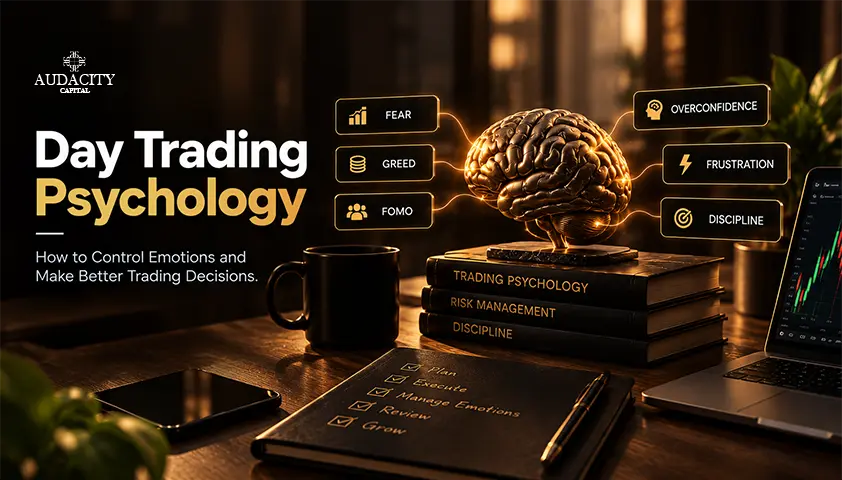
Day trading psychology is the mental side of making quick decisions when the outcome is never certain. A sound strategy can still fall apart when fear, greed, FOMO, overconfidence, or frustration takes control. That is why the psychology of day trading deserves as much attention as charts and market analysis. The aim is not to remove emotion, because that is unrealistic. Instead, you need a process that keeps emotion from deciding when to enter, exit, or increase risk. FINRA also warns that day trading carries significant risks, particularly when margin is involved.
Disclaimer: Day trading involves substantial risk and can result in significant losses. Past performance does not guarantee future results.
What Is Day Trading Psychology?
Day trading psychology covers the thoughts, emotions, and habits that influence how you make decisions before, during, and after a trade. You are dealing with uncertainty, changing prices, financial risk, and a constant stream of decisions, often within minutes.
Several factors shape that process:
- Decision-making: You must act on incomplete information and not wait for certainty.
- Risk perception: A potential $100 loss can feel very different before and after you enter a position.
- Emotional control: Fear, excitement, and frustration can change how you interpret the same market setup.
- Discipline: You need to follow your trading rules even when the market gives you a reason to abandon them.
- Attention: Long sessions and repeated decisions can make concentration harder to maintain.
- Cognitive bias: Confirmation bias, loss aversion, and overconfidence can quietly influence your choices.
Why does psychology matter in day trading?
Day trading creates a particular type of pressure because feedback arrives quickly. You can enter a position, see it move against you within seconds, take a loss, and then face another setup moments later. The previous result can easily influence the next decision.
Leverage can add another layer of pressure because it increases the financial effect of price movements. FINRA notes that day trading on margin can expose traders to losses beyond their initial investment.
That is why the strongest lessons from day trading success stories are the ones that reveal how traders handle uncertainty, losses, waiting, and repeated decisions.
The Psychology Behind a Day Trade
The easiest way to understand trading behaviour is to follow a trade from beginning to end. Your mental state changes as the decision moves from an idea to an open position and finally to a completed trade.
Before entering a trade
The first psychological battle begins before you place the order.
You see a setup forming and naturally start looking for evidence that supports it. That is where confirmation bias can creep in. Instead of asking whether the trade still meets your rules, you may start searching for reasons to justify the entry.
FOMO can create another problem. If a stock has already started moving, you may feel that waiting means missing the opportunity. A recent run of winning trades can also create overconfidence, making the next setup appear safer than it really is.
Before entering, ask yourself:
- Does the setup meet the rules of the strategy?
- Where is the trade invalidated?
- How much are you prepared to lose?
- Would you still take the trade if you had not seen the recent price move?
Those questions move the decision away from impulse and back towards process.
While the trade is open
Once money is at risk, the character of the decision changes. You are now watching an outcome that affects your account.
A losing position can create the urge to move the stop farther away. A winning position can create the opposite temptation of closing too early because you do not want the profit to disappear.
Some common reactions include:
- Moving a stop after the market approaches it.
- Adding to a losing position without a planned reason.
- Taking profits before the original exit condition.
- Checking the unrealised P&L instead of following the setup.
- Increasing position size because the trade feels unusually certain.
These actions often begin as emotional responses.
After closing the trade
You may finalize the trade, but its psychological effect can continue into the next one.
- A loss may produce frustration and the urge to recover the money immediately. That can lead to revenge trading, where the next position receives less scrutiny and more risk simply because the previous trade ended badly.
- A large win can create a different problem. You may begin to believe that your judgement is more reliable than it actually is and take the next trade with unnecessary confidence.
- Hindsight creates another trap. If a stock continues rising after you sell, it is easy to believe that you exited too early, even when the original exit followed your plan.
Good day trading psychology tips therefore focus less on trying to feel nothing and more on recognising these reactions before they change your behaviour.

Trade with Audacity Capital
Trade NowCommon Psychological Biases in Day Trading

A large part of the psychology of day trading comes down to how you interpret what has just happened. A winning trade can make the next opportunity look better than it is. A loss can make you desperate to prove yourself right. Neither reaction necessarily reflects what the market is actually offering.
Research on investor behaviour has linked overconfidence with more frequent trading, while studies of individual day traders have found evidence of overconfidence and biased interpretation of information.
Bias or behaviour | How it can appear in trading | What it can lead to |
Overconfidence | Increasing size after several wins | Taking more risk than planned |
Loss aversion | Holding a losing trade because closing it makes the loss real | Larger losses |
Confirmation bias | Looking mainly for information that supports your trade | Ignoring warning signs |
FOMO | Entering after a price move has already begun | Chasing the market |
Recency bias | Letting the last few trades influence your view of the strategy | Constantly changing your approach |
Anchoring | Fixating on an entry price or previous high or low | Ignoring what the market is doing now |
Revenge trading | Entering again quickly to recover a loss | Emotional overtrading |
These reactions are easy to recognise in hindsight, but once money is at risk, difficulty kicks in.
Why recognising a bias is not enough?
Realising that you suffer from FOMO does not automatically stop you from chasing the next move. Similarly, understanding loss aversion does not make it comfortable to close a losing position.
That is why useful day trading psychology tips should focus on the process surrounding a decision, not on trying to become emotionless. A written entry condition, predefined risk, planned exit, and a rule for stopping after a poor trading session can reduce the number of decisions you make while under pressure.
The wider evidence supports this approach. The SEC has long warned that day trading involves substantial risk and that traders need to understand the risks before committing capital.
The practical lesson from many day trading success stories is therefore not that successful traders never feel fear or doubt, but that their trading process gives those feelings less room to dictate the next trade.
From Bias to Behaviour
Recognising a bias is useful, but recognition alone does not change what you do when money is at risk. Loss aversion may still tempt you to move a stop, while FOMO can turn a missed setup into a late entry. After a losing trade, frustration can quickly become revenge trading. Likewise, a winning streak can make overconfidence feel like confidence.
The important question is, therefore, whether these reactions change your actions. A written setup, predefined risk, planned exit, and clear stopping rule can create a barrier between an emotional response and the next decision. That is where effective day trading psychology tips become practical because they turn awareness into a repeatable process rather than relying on willpower in the moment.
How to Improve Your Day Trading Psychology?
Improving day trading psychology requires removing unnecessary decisions from moments when pressure is highest. The aim is simple: decide how you will trade before the market gives you a reason to abandon your plan.
1. Build a written trading plan
A trading plan gives you something firm to follow when the market becomes noisy. Before you trade, decide:
- Which markets and setups you will trade?
- What must happen before you enter?
- Where the trade becomes invalid?
- How much capital you are willing to risk?
- Where will you take profits or close the position?
- Which conditions will make you stay out?
This matters because a decision made calmly before the trade is usually easier to follow than one made while watching a position move against you.
2. Use position sizing to reduce emotional pressure
Position size should follow risk, not confidence. If an ordinary price fluctuation makes you want to move a stop, close a position early, or stare constantly at your P&L, the trade is too large for you.
A useful relationship is:
Account Size → Acceptable Loss → Stop Distance → Position Size
3. Set rules for losses
Decide your limits before the first trade, such as:
- A maximum loss for one position.
- A maximum loss for the session.
- A limit on consecutive losing trades.
- A point at which you stop trading for the day.
There is no universal percentage that every trader must use. The important part is having a limit that prevents one difficult session from turning into an emotional attempt to recover money.
4. Wait for your setup
FOMO is easier to manage when you accept that being out of the market is sometimes the correct position. If the setup is not there, you do not need to manufacture one. Waiting protects you from entering simply because a stock has started moving without you.
5. Accept that losing trades happen
A losing trade does not automatically prove that your strategy failed. Trading works through probabilities, so even a carefully planned position can lose.
The better question is whether you followed the process you had already decided to follow.
6. Take breaks
Step away after a substantial loss, an unusually large win, several consecutive trades, or any moment when frustration starts influencing your decisions.
7. Review behaviour, not just P&L
A profitable trade can still be badly executed, while a losing trade can follow the plan perfectly, so review both. This is one of the most useful principles in day trading psychology, because it shifts attention from whether the market rewarded you to whether you made the decision you intended to make.
How a Trading Journal Can Improve Your Psychology?
A trading journal is much more useful when it records why you made a decision, not just what you bought and sold. That distinction can turn psychology of day trading from a vague idea into something you can examine in your own behaviour.
Before the trade, record:
- What is the setup?
- Why am I entering?
- Where is the invalidation point?
- What is the planned risk?
- Am I calm, anxious, impatient, or eager?
- Am I entering because the setup is valid, or because I fear missing the move?
During the trade, record:
- Did the position behave as expected?
- Did I watch P&L more closely than price action?
- Did I feel an urge to move the stop?
- Did I change the target?
- Did I chase the price after entry?
After the trade, record:
- Was the exit planned?
- Did I follow the trading plan?
- Was the mistake technical or psychological?
- Did the result influence how you viewed the next trade?
- What behaviour should be repeated or removed?
The real value appears when you have enough entries to spot repetition. Suppose 50 journal entries show that you repeatedly increase your position after two consecutive losses. That is far more useful than writing "I need more discipline." You have identified a specific behaviour that can be changed.
Your journal can therefore become a record of day trading psychology tips that actually apply to you. The question changes from "How do I control my emotions?" to "When does this particular emotion change the way I trade?"
That is a much easier problem to work on.
Day Trading Psychology Tips for Building Discipline

The most useful day trading psychology tips are practical enough to use before and during a trading session. Discipline is easier to maintain when the rule is clear, and the decision has already been made.
- Trade only defined setups - Do not enter simply because a market is moving.
- Decide risk before entering - Know your position size and invalidation point before placing the order.
- Do not increase size to recover a loss - A losing trade should not determine the risk of the next one.
- Record emotional triggers - Note when fear, impatience, FOMO, or frustration changes your behaviour.
- Use a cool-off period - If a trade leaves you angry or unusually excited, step away before making another decision.
- Review execution regularly - Look for repeated mistakes rather than isolated bad trades.
- Judge the process before the outcome - A disciplined loss is not necessarily a bad trade, just as a lucky profit is not necessarily a good one.
These habits also reinforce the broader psychology of day trading because they move decisions away from the heat of the moment and into a process you have already established.
What Successful Day Traders Understand About Psychology?
The phrase day trading success stories is tempting because a large winning trade makes for a better story than a quiet day spent following a plan. Yet individual success stories tell you very little about how often a strategy works, how much risk was taken, or what happened during the losing periods.
Successful trading does not require every position to produce a profit. A trader can have losing trades while still following a sound process. Likewise, one unusually profitable position does not prove that the decision was sound.
Several principles therefore matter more than the headline result:
- Expect uncertainty - No setup guarantees an outcome.
- Think in series rather than single trades - One result tells you very little about a process.
- Protect the decision-making process - A strategy cannot help if you repeatedly abandon it.
- Separate skill from luck - A profitable result can come from a poor decision, just as a good decision can produce a loss.
- Study drawdowns as well as wins - They reveal how a process behaves when conditions become difficult.
The strongest lesson from psychology of day trading is therefore rather plain:
Consistency is built through repeatable decisions, not through the expectation of repeating someone else's exceptional result.
Books and Resources on the Psychology of Day Trading
If you are looking for a psychology of day trading book, choose one that addresses the particular problem you are trying to understand rather than collecting titles for their own sake.
These three established resources cover different parts of the subject:
- Trading in the Zone by Mark Douglas focuses on probabilistic thinking, risk, and the mental habits that can interfere with consistent execution. Penguin Random House lists the book as a 2001 publication and describes its focus on trading errors, risk, and probabilities.
- Thinking, Fast and Slow by Daniel Kahneman provides useful background for understanding cognitive shortcuts and decision-making under uncertainty.
- The Mental Game of Trading by Jared Tendler takes a more practical approach to recurring problems such as chasing, cutting winners short, forcing trades, and overtrading. Tendler describes the book as a step-by-step system for identifying and addressing these problems.
The important point is that reading about psychology of day trading book does not replace practice. A book can give you a useful framework, but your journal is where you discover whether the same problem appears in your own trading.
Wrapping Up.
Good day trading psychology does not mean becoming emotionless. It means building a trading process that still works when fear, greed, frustration, or excitement enters the room.
If you are a trader looking to develop skills with structured support, explore Audacity Capital's trading programmes and resources.
FAQs
Day trading requires repeated decisions under uncertainty, while prices, profits, and losses can change within minutes.
To stay calm, reduce the number of decisions you make under pressure. A written trading plan, defined risk, planned exits, and breaks can help keep emotions from driving the next trade.
Several successful trades can increase confidence beyond what the results justify. A trader may then increase position size or take setups that would normally be rejected. Overconfidence is usually associated with more frequent trading.
Decide in advance what qualifies as a trade and accept that missing a move is better than entering without a valid setup. This gives you a clear reason to stay out.
Yes, but there is no universal number. A trader can set a personal session-loss limit or consecutive-loss rule so that one difficult period does not turn into increasingly emotional trading.

Ready to apply disciplined risk to crypto? Explore Audacity Capital's new crypto instruments and bring your trading strategy.
Learn MoreNewsletter
Join our newsletter to stay up to date on features and releases.
Join Our Social & Community

Start Your Journey Today With Our Free Trial
Proudly showcase your skills and accomplishments through certificates and get recognition for your hard work and dedication from potential investors and peers.
Free Trial