



Buy Stop, Sell Stop, and Stop-Limit Orders Explained



Most traders lose money not because they pick the wrong direction, but because they get into a trade at the wrong price, or miss the move entirely while waiting to click. Pending orders fix that. They tell your broker exactly when to act, so you can walk away from the screen and let the setup come to you.
The trouble is that four order types get muddled together all the time: the buy stop, the sell stop, and their limit-price cousins, the buy stop limit and sell stop limit. This guide sorts them out in plain terms, shows you when each one earns its place, and walks through the breakout strategy that puts stop orders to work. The examples use forex pairs, but the logic is the same on any market.
THE SHORT ANSWER A buy stop buys once price climbs to a level above the market, catching an upside breakout. A sell stop sells once price drops to a level below the market, catching a breakdown. Both fill at the next available price, so speed is the priority. A stop-limit order adds a second price, the limit, that caps the worst fill you will accept. You trade a little certainty of getting filled for full control over price. |
Stop orders vs limit orders: the difference that trips people up
Every pending order is built from one of two ideas, and once you see the split, the rest falls into place.
A stop order sits dormant until price reaches your trigger level, then turns into a market order and fills at the next available price. You are guaranteed to get in; you are not guaranteed the exact price. That is why stops are the tool of choice for breakouts, where getting on board matters more than shaving a pip.
A limit order does the opposite. It fills only at your chosen price or better, and if the market never trades there, it simply waits. You control the price; you risk never being filled. Limits suit traders who want to buy a dip or sell a rally at a specific level.
A stop-limit order is the two ideas stitched together. The stop price triggers the order, and the limit price sets a ceiling (or floor) on the fill. More on that below, once the plain stops are clear.
Buy stop, sell stop, buy limit, sell limit: the four pending orders
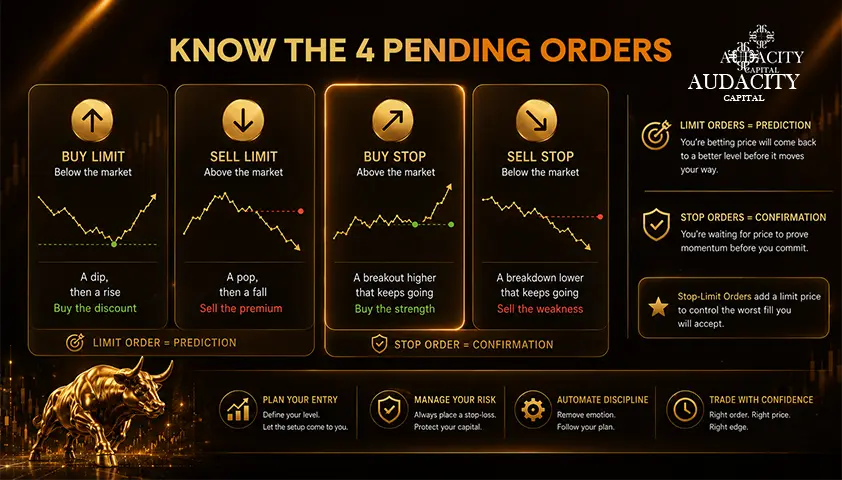
There is a clean way to hold all four in your head. Limit orders are a prediction; you are betting price will come back to a better level before it moves your way. Stop orders are a confirmation; you are waiting for price to prove momentum before you commit. Here is the full map:
Order type | Placed | It triggers a | Use it when you expect | The logic |
|---|---|---|---|---|
Buy Limit | Below the market | Buy | A dip, then a rise | Buy the discount (prediction) |
Sell Limit | Above the market | Sell | A pop, then a fall | Sell the premium (prediction) |
Buy Stop | Above the market | Buy | A breakout higher that keeps going | Buy the strength (confirmation) |
Sell Stop | Below the market | Sell | A breakdown lower that keeps going | Sell the weakness (confirmation) |
The two stop-limit versions are the same buy stop and sell stop, with a limit price bolted on to cap how far your fill can drift. The rest of this guide zeroes in on the stops, since those are the ones traders reach for on breakouts and the ones that cause the most confusion.
What is a buy stop order?
A buy stop is an instruction to buy once price rises to a level you set above the current market, at which point it becomes a market order and fills. Traders use it to enter a long position on a confirmed upside breakout, rather than guessing that a level will break.
Say EUR/USD is trading at 1.4500 and a clear resistance ceiling sits at 1.4600. You do not want to buy while price is still stuck under resistance, but you do want in if buyers push through. You place a buy stop at 1.4605, just above the ceiling. If price breaks and trades there, your long opens automatically and you ride the move. If the breakout never comes, nothing happens and you have risked nothing.
The catch is the false breakout: price nudges through 1.4605, triggers your entry, then rolls back over. That is the cost of trading confirmation, and it is why a buy stop entry always needs a stop-loss underneath it.
What is a sell stop order?
A sell stop is the mirror image: an order to sell once price falls to a level below the current market, used to catch a downside breakout. It can also work as a stop-loss on an existing long position, closing you out if price breaks support.
If GBP/USD trades at 1.3000 with support at 1.2950, a trader who expects a deeper slide places a sell stop at 1.2945. When price cracks that floor, the short opens and rides the drop. As with the buy stop, the main risk is a fakeout, where price dips just far enough to trigger the order before snapping back up.
What is a stop-limit order?
A stop-limit order combines a stop trigger with a limit price. When the market reaches your stop price, the order does not fill at market. Instead it places a limit order at your limit price, which fills only at that price or better. In practice, the limit sets the worst price you are willing to accept, which is the whole reason to use one: it protects you from ugly slippage when a breakout runs fast.
The trade-off is real. If price gaps or rockets straight past your limit, the order sits unfilled and you miss the trade. So a stop-limit order buys you price control at the cost of fill certainty. There are two versions.
Buy stop limit
A buy stop limit is set above the market and used when you want to buy a breakout but refuse to overpay on a spike. Back to EUR/USD at 1.4500 with resistance at 1.4600. You set the stop (the trigger) at 1.4600 and the limit (your ceiling) at 1.4620. When price hits 1.4600, a buy limit at 1.4620 goes live and fills anything up to that price. If the breakout is so violent that price blows past 1.4620 before you are filled, you stay out, by design.
Sell stop limit
A sell stop limit is set below the market for a breakdown you want to sell without accepting a terrible fill. With EUR/USD at 1.2500 and support at 1.2400, you place the stop at 1.2400 and the limit (your floor) at 1.2380. When price hits 1.2400, a sell limit at 1.2380 activates and fills at that price or higher. If price craters through 1.2380 first, the order waits rather than dumping you in at any price.
Buy Stop and Sell Stop Strategy: How It Works?
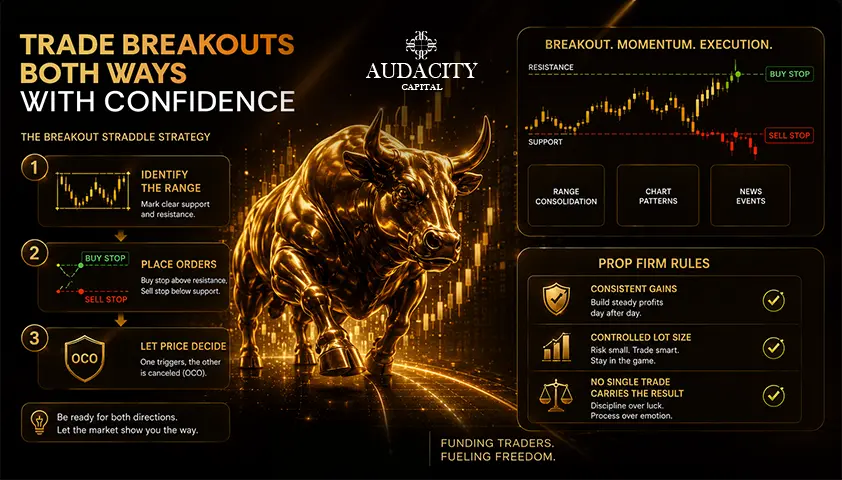
A buy stop and sell stop strategy uses pending orders above and below a defined price range to participate in a breakout without predicting the direction in advance. A buy stop is placed above resistance, while a sell stop is placed below support. When price breaks one of these levels, the corresponding order can trigger.
How the Buy Stop and Sell Stop Strategy Works
- Identify a clear trading range
Mark the key resistance and support levels. - Place a buy stop above resistance
Set the buy stop slightly above the resistance level to capture an upside breakout. - Place a sell stop below support
Set the sell stop slightly below support to capture a downside breakout. - Wait for one order to trigger
If price breaks resistance, the buy stop can trigger. If price breaks support, the sell stop can trigger. - Cancel the opposite order
Once one order is triggered, cancel the other pending order or use an OCO setup where supported. - Manage risk
Define your stop-loss and position size before placing the orders.
Buy Stop and Sell Stop Strategy Example
Market condition | Order | Placement | Expected move |
|---|---|---|---|
Price consolidates between support and resistance | Buy Stop | Above resistance | Upside breakout |
Price consolidates between support and resistance | Sell Stop | Below support | Downside breakout |
Example:
Suppose EUR/USD is trading between 1.1000 support and 1.1050 resistance. A trader could place a buy stop slightly above 1.1050 and a sell stop slightly below 1.1000. If price breaks upward, the buy stop may trigger. If price breaks downward, the sell stop may trigger.
The current article already explains the mechanics of placing both orders around a range and cancelling the untriggered order, so this expansion should deepen the search intent rather than introduce a completely new concept.
The honest caveats
This is not free money, and pretending otherwise is how accounts get hurt. Three things go wrong often enough that you should plan for them:
- False breakouts. Price pokes past the level, triggers you in, then reverses. In choppy conditions this happens repeatedly, and each fakeout is a small loss.
- Whipsaw. A violent two-way spike, common on news, can trigger both orders in seconds and hand you two losing trades at once. An OCO pair prevents the second fill; it does not prevent the first bad one.
- Slippage and gaps. Around high-impact news and over weekends, spreads widen and price can jump clean over your level. A plain stop fills at the next available price (worse than you wanted); a stop-limit may not fill at all.
Using these orders for risk management
Beyond entries, stops are a discipline tool. A sell stop placed below a long position, or a buy stop above a short, defines your exit before emotion gets a vote, so a losing trade closes at a planned level instead of a panicked one. That is the core of surviving as a trader: knowing where you are wrong before you are in.
A quick reality check that the sales pages skip: no pending order is guaranteed to execute at your price, and some are not guaranteed to execute at all. A stop-limit can be left behind if price gaps past the limit. Build that into the plan rather than assuming the fill.
A few things that catch traders out
- Placing stops too tight to the level, so normal noise triggers them before the real move.
- Forgetting the spread. Your order triggers on the ask (buys) or bid (sells), not the mid-price you see on the chart.
- Confusing a stop-limit order with a plain stop, then wondering why a fast breakout left the order unfilled.
- Entering on a breakout with no stop-loss, which turns a small false-breakout loss into a large one.
How prop firms use these orders
Proprietary trading firms lean on precise order types because their whole model runs on risk control. Traders on a funded account work inside defined daily loss and drawdown limits, so clean entries and pre-planned exits are not optional extras, they are how you stay in the program.
At Audacity Capital, the platforms are MetaTrader 5 and DXTrade, both of which support buy stop, sell stop, and stop-limit orders natively. The point of trading with a firm is not that these orders make you profitable, no order type does that, but that you get real buying power and a rules-based structure without risking your own savings on a high-leverage account. Traders keep up to 90% of the profit they generate, and accounts can scale toward $2 million as performance holds up. The capital and the guardrails are the edge; the strategy is still on you.
The bottom line
Buy stops and sell stops are confirmation tools: they get you into a move once the market proves it, which is why they suit breakouts and trend continuation. Add a limit price and you get a stop-limit order that caps your fill at the cost of sometimes missing it. Pair a buy stop and a sell stop around a range and you have a straddle that trades a breakout in either direction, as long as you respect false breakouts, whipsaw, and slippage. Learn where each one fits, always trade with a stop-loss, and these orders become a quiet, reliable part of your process.
Frequently asked questions
Not quite. A buy stop is usually an entry order that opens a long above the market on a breakout. A stop-loss is an exit that closes an existing position to cap a loss. The confusion comes because a sell stop can do both jobs: as an entry it catches a breakdown, and placed under a long it acts as your stop-loss.
Yes. A plain buy stop becomes a market order the moment it triggers, so it fills at the next available price. In a fast breakout or a news spike, that can be several pips above your trigger. If controlling the fill matters more than guaranteeing it, use a buy stop limit instead.
Nothing, and that is fine. The order rests unfilled until price touches your level, until it expires, or until you cancel it. You can set most orders as good-till-cancelled or give them an expiry time, so an untriggered order does not linger for weeks and fire on a setup you have forgotten.
In forex, the market trades around the clock on weekdays, so a resting order can trigger while you sleep. Over the weekend the market is closed, and price can open Monday with a gap. If it gaps past your level, a plain stop fills at the new price and a stop-limit may not fill at all.
That is whipsaw. Price spiked hard in one direction, triggered one order, then reversed just as hard and triggered the other, leaving you with two positions. It is the main downside of the straddle. Linking the two as an OCO pair cancels the second order the instant the first one fills.
They are, and they build good habits by forcing you to define entries and exits in advance instead of trading on impulse. The one thing a beginner must internalise first is the false breakout, since trading confirmation means you will take small losses when a level breaks and then fails. Always pair the entry with a stop-loss.
Yes. MetaTrader 5 supports buy stop, sell stop, buy stop limit, and sell stop limit as pending order types, and DXTrade offers the same set. You set the trigger price (and the limit price for the stop-limit versions) in the order ticket, and the platform handles the rest.
A buy stop and sell stop strategy uses a buy stop above resistance and a sell stop below support to prepare for a breakout in either direction. When one order triggers, the trader can cancel the opposite pending order or use an OCO order where available. The strategy is designed to participate in a breakout without having to predict its direction in advance.

Ready to apply disciplined risk to crypto? Explore Audacity Capital's new crypto instruments and bring your trading strategy.
Learn MoreNewsletter
Join our newsletter to stay up to date on features and releases.
Join Our Social & Community

Start Your Journey Today With Our Free Trial
Proudly showcase your skills and accomplishments through certificates and get recognition for your hard work and dedication from potential investors and peers.
Free TrialRelated Articles

Introducing Ability One: One Step To Funding With Static Drawdown


Swing Trading vs Day Trading: Which Is Right for You?
One style costs you your afternoons. The other costs you your sleep. Here is how swing trading vs day trading really compare, and how to pick.
__webp__orig.webp)
From Demo To Live: When Are You Ready To Go Live?

10 Best Futures Prop Firms for Swing Trading In 2026
Compare the best futures prop firms for swing trading in 2026 with overnight holding, flexible rules, fast payouts, and funded accounts.