



Forex Trading Strategies: Types, Examples and How to Choose


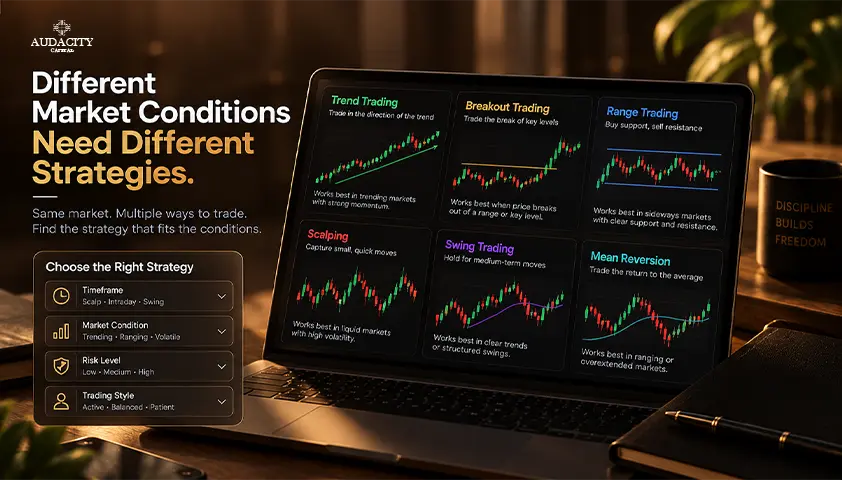
If you look up different forex trading strategies, you will encounter terms such as scalping, swing trading, breakouts, carry trades, often presented as answers to the same question. They don’t.
Some refer to the time that you trade a position. Some refer to how you discover an opportunity to trade a market.
The main difference between scalping, day trading, swing trading and position trading is the time frame. Trend, range, breakout, carry and news trading are about methodology: the logic you use to decide when a market is worth trading.
You can mix one of each. For instance, a swing trader using a breakout strategy.
You will learn what a complete strategy is and how 10 popular currency trading strategies work. You will also learn about the differences in holding-period styles and how to select, structure and test a style that is appropriate to your time frame, temperament and risk tolerance.
What Are Forex Trading Strategies?
A Forex Trading Strategy is a consistent plan, or a set of rules, that direct your trading choices. It’s designed to eliminate this guesswork and replace it with a process that can be used the same way each time and then reviewed later.
Many traders view a strategy as an indicator that will tell them when to buy or sell. This is just a part. A comprehensive plan outlines:
- Currency pair: Which markets the rules apply to.
- Market condition: Trend, range, breakout or event-based movement.
- Entry signal: What signal tells you to enter the position.
- Stop or invalidation point: Where the trade idea is indicated to be incorrect.
- Exit strategy: What method to use for exiting the trade.
- Position size and risk: How much capital you risk in a position.
- No-trade conditions: If a setup is seen, don't trade it.
Strategies can draw on technical analysis (chart patterns, levels and forex indicators), fundamental analysis (interest rates, inflation, economic data and central-bank policy), price action or a combination.
There are no automatic advantages of any input. The rules should be clear and unambiguous, and specific enough to be tested.
If a trader claims a strategy has 'failed' one of these factors may not have been clearly defined in the first place.
Trading Style vs Forex Trading Strategy
These concepts are often confused, but answer two distinct questions:
- Trading Style: For how long do I keep my trades open, and how much time do I spend observing the market?
- Trading Strategy: What reasoning do I employ when looking for and dealing with opportunities?
A trend-following approach can be applied by a day trader on a 15-minute chart, a swing trader on a 4-hour chart or a position trader on a weekly chart. The approach remains unchanged.
The holding period, monitoring load and trading costs change completely. The holding period you use needs to match your lifestyle first then you need to select the methodology that works for the markets you're trading in.
Holding-Period Styles
Style | What it describes | Typical holding period |
Scalping | Very short trades that focus on small moves. | Seconds to minutes |
Day trading | Positions opened and closed the same day | Minutes to hours |
Swing trading | Positions capturing multi-day swings | Days to weeks |
Position trading | Broad themes with longer-term positions | Weeks to months |
Strategy Methodologies
Methodology | Core logic |
Trend trading | Trade in the direction of an established move |
Range trading | Trade between defined support and resistance |
Breakout trading | Trade movement beyond a defined boundary |
Retracement trading | Enter during a temporary move against the trend |
News trading | Trade around scheduled economic events |
Carry trading | Seek exposure to an interest-rate differential |
10 Forex Trading Strategies and How They Work
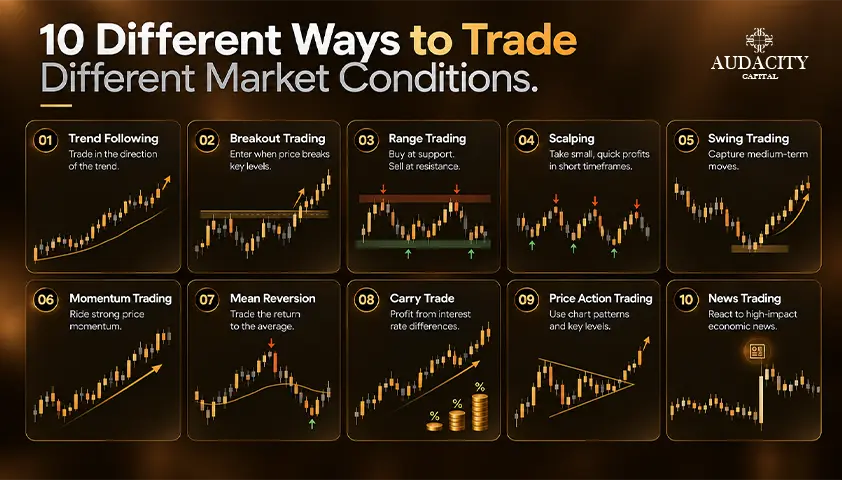
The strategies below are not ranked from best to worst. Each works differently and suits different market conditions, trading styles and timeframes.
1. Trend Trading Strategy
What it means: A trend trading strategy is a strategy that trades on a clear trend in the market. Traders wish to buy when the price is going up and sell when the price is falling.
Suitable market condition: Higher highs and higher lows, or lower highs and lower lows, with directional follow-through.
Common tools and signals: Moving averages, trend lines, Average Directional Index (ADX) to gauge trend strength and momentum indicators for confirmation.
Major benefit: A solid position can take a significant part of a powerful market move.
The biggest drawback: Sideways markets and false market indicators may result in a series of small losses.
Related reading: Audacity Capital's guide to identifying market trends.
2. Range Trading Strategy
What it means: A range trading strategy entails using support and resistance when price gets close to either of the two boundaries; buy when price approaches the support level and sell when price approaches the resistance level.
Ideal market condition: Sideways market that has been tested by both resistance and support levels several times.
Common tools and signals: Horizontal levels, rejection candles, RSI and stochastic indicators which will help you determine if a boundary move is losing momentum.
Primary advantage: It is easy to specify entries, stops and targets with clear reference points.
Major disadvantage: Reversal traders could find themselves on the wrong side in case of a real break, thus need for stops above the boundary.
Related reading: Audacity Capital's support and resistance guide.
3. Breakout Trading Strategy
How to use it: A breakout trading strategy is based on a key level or consolidation and then waits for another decisive movement beyond the level as pressure builds up and is released.
Suitable market condition: Markets shifting from compression to expansion, such as tight consolidations, triangles or well-tested levels.
Common tools and signals: Horizontal levels, chart patterns and Average True Range. In the forex trading world, there is not much volume data around and some traders use tick volume or timing of the session as additional context.
The primary advantage: A real breakout provides an early entry that comes with a well-established invalidation level.
The main drawback: False breakouts are frequent and not all breakouts warrant a trade. The use of filters (candle close beyond the level, retest) can limit exposure to fakeouts.
Related reading: Audacity Capital's guide to chart patterns and breakouts.
4. Retracement or Pullback Trading Strategy
What it is: A retracement trade goes into an ongoing trend when there is a temporary change in the trend against itself. A retracement is a rest within the trend while reversal is a change in direction.
Best suited market environment: Trend correction in the direction where buying or selling took place in the past.
Common indicators and signals: Support and resistance, previous breakout levels, moving averages, and Fibonacci retracements (as an example).
Major benefit: Pullback entries tend to offer narrower ranges than a lengthy move.
Main limitation: Every reversal starts by looking like a pullback. You require a set of rules, such as “setup is invalid if price breaks the most recent higher low.”
Related reading: Audacity Capital's guide to Fibonacci retracements.
5. Price Action Trading
What it is: In price action trading, there is use of relatively clear charts where decision-making is based on price action as opposed to indicators.
Suitable market condition: Trends, ranges and breakouts. Flexibility is part of the appeal.
Common tools and signals: Support and resistance, candlestick patterns, market structure (high-low patterns), and breakouts and rejections at significant levels.
Major advantage: It creates a skill that one can apply to all currencies across time frames.
Major disadvantage: The analysis is subjective. There being no written rules, it is difficult to test and easily justifiable afterwards..
Related reading: Audacity Capital's price action and candlestick pattern guides.
6. Momentum Trading Strategy
What it is: A momentum strategy is based on markets exhibiting growing directional momentum. Trend is concerned with direction, and momentum with speed/force of movement. Trend may continue even as momentum wanes.
Suitable market condition: Markets accelerating after a catalyst, breakout or shift in sentiment.
Common tools and signals: RSI, MACD and rate-of-change indicators are used as inputs.
Primary benefit: This helps to pay attention to the markets where something is happening.
Main limitation: A market can remain "overbought" for quite some time despite a strong move and being oversold does not necessarily imply that the price is about to reverse.
Related reading: Audacity Capital's guide to RSI and MACD.
7. News Trading Strategy
What it is: A news trading strategy is based on the movement of currencies around macroeconomic information.
Suitable market condition: The high-impact event includes news such as inflation data, employment data like US Non-Farm Payrolls, and interest rate change of central banks.
Common tools and signals: Economic calendar containing the time of release, expected effect, forecast and previous figures. Some traders trade the initial reaction whereas some trade the response.
Advantages: As the timing of the event is already known, the move can be very quick and sharp.
Disadvantages: Volatility, spreads widening, slippage and sudden reversals. Audacity Capital supports news trading but doesn’t give room for trading all news events.
Related reading: Audacity Capital's news trading guide.
8. Carry Trade Strategy
What it does: A carry trade is one that involves purchasing a high-yielding currency and selling a low-yielding currency, in order to obtain exposure to the interest-rate differential.
Overnight holding can yield positive rollover or swap, depending on conditions with the broker.
Suitable market condition: Stable markets or risk-on markets that have a significant rate spread.
Common tools and signals: Central-bank expectations, swap rates, risk sentiment and technical timing tools.
The biggest benefit: A possible return source that's not just based on price movement.
Main drawbacks: The adverse currency moves can offset the rate benefit, and carry trades have historically been vulnerable when it comes to risk-off unwinds.
9. Mean Reversion Strategy
What it is: Mean reversion theory states that if the price has deviated significantly from an average or equilibrium level, it will likely move back towards the average.
Suitable market condition: Balanced or ranging markets oscillating around a central value.
Common tools and signals: Moving averages, Bollinger Bands, support and resistance, and oscillators.
Main advantage: Frequent setup in stable markets with clearly defined risk at extremes.
Main limitation: An apparent extreme can be the start of a strong trend. Firm invalidation rules are essential.
Related reading: Audacity Capital's guide to Bollinger Bands.
10. Grid Trading Strategy
What it is: Grid trading places multiple orders at predetermined levels above and below a reference price, which gets activated and closed with price movement.
Suitable market condition: Depends on implementation. Some grids focus on ranges, others on direction.
Common tools and signals: Grid spacing, order size, number of levels and exposure limits. Many grids run through Expert Advisors (EAs), which Audacity Capital permits.
Main advantage: Less need to predict direction precisely, and the approach can be fully systematised.
The biggest drawback: They can get "exposed" and have "open" positions fast when the market is trending against a poorly managed grid. Hard exposure caps are a must.
Related reading: Audacity Capital's guide to Expert Advisors.
Compare Forex Trading Strategies
This table compares characteristics, not predicted profitability.
Strategy | Best suited market | Typical timeframe | Analysis type | Screen time | Main challenge |
Trend | Directional | Any | Technical | Moderate | Sideways chop |
Range | Sideways | Intraday to swing | Technical | Moderate | Genuine breakouts |
Breakout | Compression to expansion | Intraday to swing | Technical | Moderate to high | False breakouts |
Retracement | Correcting trend | Intraday to swing | Technical | Moderate | Pullback vs reversal |
Price action | Flexible | Any | Technical | Moderate | Subjectivity |
Momentum | Accelerating | Intraday to swing | Technical | Moderate to high | Sudden fades |
News | Event-driven | Very short to intraday | Fundamental and technical | High around events | Slippage and spreads |
Carry | Stable, risk-on | Weeks to months | Fundamental | Low | Risk-off unwinds |
Mean reversion | Balanced | Intraday to swing | Technical | Moderate | Emerging trends |
Grid | Implementation-dependent | Varies | Systematic | Low if automated | Exposure build-up |
Scalping vs Day Trading vs Swing Trading vs Position Trading
These styles indicate the duration of holding a trade, and each style can have multiple methodologies.
1. Scalping
A scalping strategy involves holding onto the trades for brief timeframes and requires close attention. Spreads, commissions and slippage absorb a larger proportion of each trade, due to the small size of targets.
See Audacity Capital's forex scalping guide.
2. Day Trading
A forex day trading strategy opens and closes positions within the same trading day. That does not mean one trade per day. Traders balance monitoring time, trade frequency and costs, and avoid overnight exposure.
3. Swing Trading
A forex swing trading strategy holds trades for multiple days or longer to capture price swings. Monitoring is less frequent than scalping or day trading, which suits many traders with other commitments.
See Audacity Capital's swing trading guide.
4. Position Trading
Position trading involves holding onto positions for weeks or months and has more emphasis on macro and fundamental context.
There is little trade and higher exposure to overnight and weekend events. Audacity Capital supports weekend holding, but this is a risk that requires planning.
Style | Holding period | Typical monitoring | Trade frequency | Costs most sensitive to |
Scalping | Seconds to minutes | Continuous | Very high | Spreads, commissions, slippage |
Day trading | Minutes to hours | Frequent | High to moderate | Spreads, commissions |
Swing trading | Days to weeks | Periodic | Moderate | Swap, gaps |
Position trading | Weeks to months | Occasional | Low | Swap, weekend gaps |
Read guide about Scalping Vs Swing Trading
How to Choose a Forex Trading Strategy
The best forex trading strategy for you is the one that fits your circumstances and survives testing.
1. Available Trading Time
Continuous monitoring allows shorter-term methods. If you only check charts before or after work, higher-timeframe approaches are usually more realistic.
2. Preferred Holding Period
Minutes, hours, days or weeks? Pick a trading timeframe you can hold without anxiety or interference.
3. Market Conditions
Trend strategies need direction, range methods need boundaries, breakouts need expansion and news strategies depend on event risk. Know which condition your rules require.
4. Risk Tolerance
Consider how often you can accept losses and how deep a drawdown you can manage. Also consider your typical stop distance and the volatility you are comfortable with.
5. Trading Costs
Spreads, commissions, swap and slippage affect every approach, but short-term strategies feel them most.
6. Experience and Complexity
A strategy you understand and can test beats a complicated setup copied from a forum.
Forex Trading Strategies for Beginners
No single strategy is universally best for new traders. The most useful forex strategies for beginners share a few traits: simple rules, clear invalidation and limited variables. They should also have manageable trade frequency and enough setups to evaluate properly.
Three simple forex trading strategies to study:
- Trend plus pullback: Identify the trend on a higher timeframe, then wait for a pullback to a defined level. Direction and invalidation are both easy to define.
- Support and resistance range: Trade reactions at well-tested boundaries with stops just beyond them. Levels are objective and easy to backtest.
- Simple breakout: Mark a consolidation and enter only on a candle close beyond it. One trigger keeps the rules clean.
Each works because every component can be written down and checked, which makes these forex trading strategies for beginners easier to test honestly.
Note: These are useful frameworks for learning how rules work, rather than recommendations that every beginner should trade them.
How to Build a Forex Trading Strategy

1. Define the Market and Currency Pair
Specify which currency pairs the rules apply to. Pairs differ in volatility and spread.
2. Identify the Market Condition
State whether the strategy is designed for a trend, range, breakout or event-driven environment.
3. Define the Entry
Use observable criteria, such as "a 1-hour close above the prior swing high," not vague phrases like "strong momentum."
4. Define Invalidation and Stop Placement
Decide what would prove the idea wrong and place your stop loss there, not at an arbitrary distance.
5. Define the Exit
Choose price targets, structure-based exits, trailing exits or time-based exits, and apply them consistently.
6. Define Position Sizing and Risk
Size each position from the distance to your stop and the amount you are willing to risk. Audacity Capital's position sizing guide goes deeper.
7. Define No-Trade Conditions
Examples include wide spreads, a major event approaching, thin liquidity, incomplete setup criteria or a daily risk limit already reached.


Take your trading to the next level
Start your trading journey with Audacity Capital todayExample of a Forex Trading Strategy
Example: Trend-Pullback Strategy
This is an educational example framework, not a proven profitable strategy.
- Market: EUR/USD
- Market condition: Established uptrend, with price making higher highs and higher lows above a rising 50-period moving average
- Timeframe: 4-hour chart
- Setup: Pullback toward a prior resistance level now acting as support
- Entry condition: A bullish candle closes back above that level
- Invalidation: A close below the most recent higher low, with the stop placed just beyond it
- Exit rule: Target the prior swing high, taking the trade only if that target offers the reward-to-risk defined in the plan
- No-trade condition: The trend is no longer intact, spreads are unusually wide, or a high-impact EUR or USD release is due before the setup completes
Every line is specific enough to backtest, which is the point of the exercise.
How to Test a Forex Trading Strategy
Successful forex trading strategies are usually the product of testing, not inspiration.
1. Backtesting
Backtesting applies your rules to historical data. Track the number of trades, win and loss rate, average win, average loss, maximum drawdown and trading costs.
2. Forward Testing
Forward testing runs the same rules on a demo or paper account under current conditions. It reveals execution issues that historical charts can hide.
3. Use a Sufficient Sample
A handful of trades cannot tell you much. Results need enough trades across different market conditions to separate a genuine pattern from luck.
4. Include Trading Costs
Account for spread, slippage, commissions and overnight financing. A method that looks strong before costs can look very different after them.
5. Avoid Changing the Rules Mid-Test
Adjusting rules during a test blends two systems together and makes the results impossible to interpret. Finish the test, then revise.
Risk Management for Forex Trading Strategies
Profitable forex strategies on paper can still fail without disciplined risk management. Focus on:
- Position sizing: Size trades from stop distance, not conviction.
- Stop placement: Place stops where the idea is invalidated.
- Leverage: Leverage magnifies losses as well as gains.
- Correlated positions: Several trades on related pairs can act like one large position.
- Maximum exposure: Cap total open risk at any one time.
- Drawdown awareness: Know your limits before a losing streak arrives, especially under evaluation rules.
- Risk-to-reward: A planning tool, not a guaranteed outcome.
There is no universal percentage that suits every trader. Audacity Capital's risk management guides cover these topics in more depth.
Common Forex Strategy Mistakes
Switching Strategies After a Few Losses
Strategy hopping resets your learning each time. A short losing run does not necessarily invalidate a tested method.
Choosing a Strategy Only by Win Rate
A high win rate means little if average losses dwarf average wins. Both sides of the equation matter.
Ignoring Market Conditions
The same method can behave very differently in a trend, a range or a volatile event-driven market.
Overfitting a Backtest
Tweaking rules until past results look flawless usually produces a system tuned to history rather than to future markets.
Using Too Many Indicators
Stacking forex indicators that measure similar things adds noise, not stronger confirmation.
Ignoring Trading Costs
Spreads, commissions and slippage compound quickly, especially for high-frequency methods.
Changing Rules During a Trade
Moving a stop or target on impulse is an execution failure, not a strategy failure. Separate the two when you review results.

Start Your Funded Trading Journey
Become a Funded TraderConclusion
No single approach outperforms in every market, and the search for one tends to keep traders jumping between systems.
The more useful question is practical: which strategy has rules you can understand, test, execute and evaluate under the market conditions you actually trade?
Start with a holding period that fits your schedule. Choose a methodology that matches the conditions you see most often. Write every component down, test it with realistic costs, and protect your capital with consistent sizing and clear invalidation.
Forex trading strategies are tools. Their value comes from the discipline of the trader applying them, not from the label attached to the setup.
Frequently Asked Questions
There is no universal winner. The best forex trading strategy for one trader may suit another poorly. Suitability depends on market conditions, your trading style, how clearly the rules are defined and how well the approach holds up in testing.
No strategy produces consistent profits in every market. Searching for the best forex strategy for consistent profits usually leads back to fundamentals: clear rules, realistic trading costs, disciplined risk management and consistent execution. Results always vary, and losses are part of trading.
Look for simple rules, clear invalidation, few variables and a manageable trade frequency. Trend plus pullback, support and resistance ranges and simple breakouts are common starting points because they are easy to define and test.
Simplicity means fewer variables and clearer rules, such as trading reactions at well-tested levels. A simple strategy is easier to follow and test, but it does not guarantee easier or larger profits.
Most traders benefit from learning and testing one or two approaches thoroughly. Constant switching prevents you from building a meaningful sample or understanding how a method behaves across different conditions.
A strategy provides repeatable rules and a way to measure results. It does not guarantee profitability. Whether it works for you depends on its logic, costs, risk controls and your ability to execute it consistently.
Not always. Pairs differ in liquidity, volatility, spreads and behaviour around sessions and news. Test your rules on each pair separately rather than assuming results will transfer.
Forex Trading Strategies In Depth
- Fundamental Analysis Strategies in Forex
- Trading Forex Without Leverage
- Forex Leverage Trading Strategies
- Forex Swing Trading Strategies
- Forex Crossover Moving Average Strategies
- Hedging Forex Trading Strategies
- Forex Scalping Trading Strategies
FAQ
If you are looking for the forex best strategy ever, you must consider your needs and goals. All these successful forex traders’ strategies can work for you if you put in the effort and stay focused.
Forex trading successful strategies can make you a lot of profit depending on the one you are using.

Ready to apply disciplined risk to crypto? Explore Audacity Capital's new crypto instruments and bring your trading strategy.
Learn MoreNewsletter
Join our newsletter to stay up to date on features and releases.
Join Our Social & Community

Start Your Journey Today With Our Free Trial
Proudly showcase your skills and accomplishments through certificates and get recognition for your hard work and dedication from potential investors and peers.
Free TrialRelated Articles
Inside Bar Trading Strategy: Rules, Entries and Risk Guide
Master the inside bar trading strategy with practical rules for pattern identification, entry triggers, stop placement, risk management, and testing.

Mean Reversion Trading Strategy Explained (2026)
Prices that stretch too far tend to snap back to an average, but only in the right market. Learn the tools, the setup, and the trend risk.
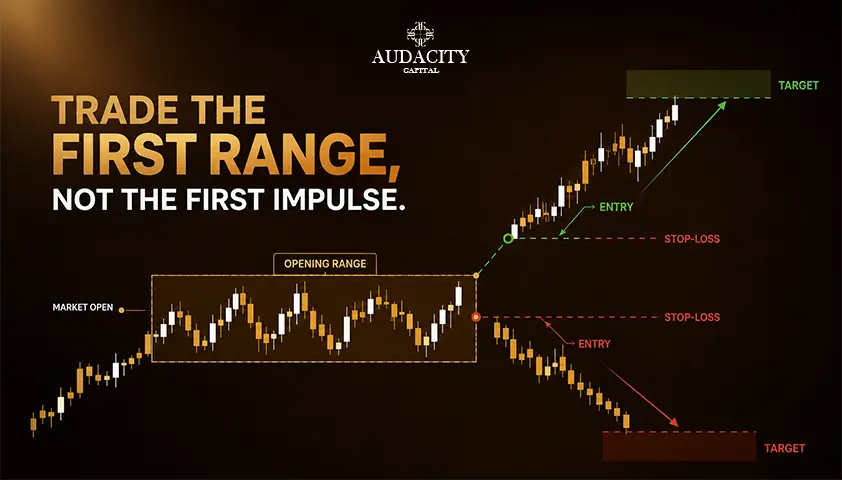
Opening Range Breakout Strategy: Rules, Setups and Examples
Learn how the opening range breakout strategy works, including ORB rules, 5, 15 and 30-minute setups, entry signals, stop losses and risk management.

Momentum Trading Strategy: A Comprehensive Guide
Master the core principles of a momentum trading strategy. Learn how to use key indicators, manage sharp-reversal risks, and master exit timing.