



Forex Economic Indicators: How Economic Data Impacts Currency Markets


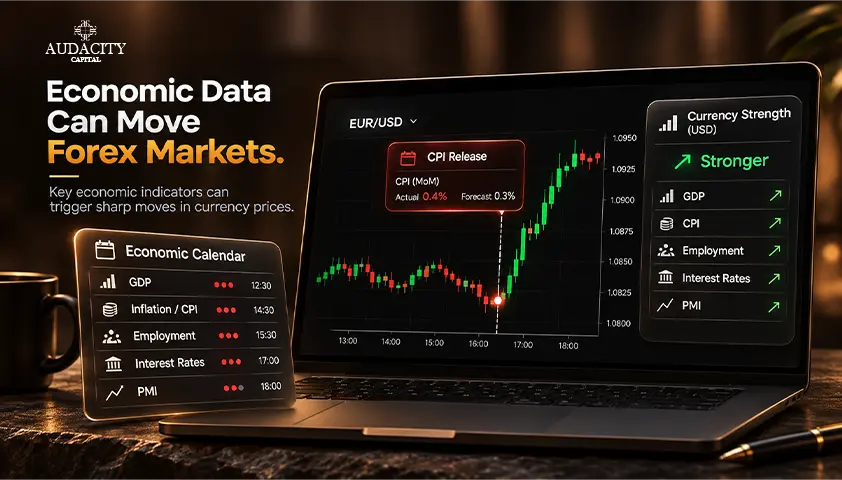
Forex economic indicators are data releases and announcements from governments, central banks and research groups that show how an economy is doing. They cover inflation, jobs, growth and interest rates. Currencies react to them because they hint at where interest rates may go next.
Not every indicator moves forex trading equally. The ones with the most impact are central bank interest rate decisions, inflation data (CPI and PCE), employment data (Non-Farm Payrolls), GDP and PMI.
A strong data result does not always lift a currency. What counts is how the figure compares with what the market expected. For example, a strong jobs report can still push a currency down if it only matches the forecast.
This guide explains what forex economic indicators are, ranks the ones that matter most, shows how each affects a currency, and covers how to prepare for a release.
What Are Economic Indicators in Forex?
Economic indicators are statistics that provide information on the current state and the direction of the economy. They are published by governments, central banks, national statistical offices, and respected research organizations and report on various subjects such as inflation, unemployment, economic growth, consumer spending, business spending.
But how does it affect you as a forex trader? It does because currency is a reflection of its economy of origin.
In cases where a certain economic release indicates that the economy is either getting stronger or weaker, expectations regarding inflation and interest rates get revised and that affects the appeal of the currency.
More growth or increased levels of inflation can point to higher rates for longer, which tends to draw investment toward that currency.
Conversely, weak figures can indicate lower interest rates and less demand. And central banks pay attention to these same numbers, their actions dictate interest rates’ movement.
In forex trading economics, there's more to it than just the numbers themselves; it's about understanding what they could mean for future actions by the central bank.
Economic data is among the primary basics of forex fundamental analysis. They are used by traders to develop their opinion on a particular currency and adjust their trading strategies accordingly.
Why Do Economic Indicators Move Forex Markets?
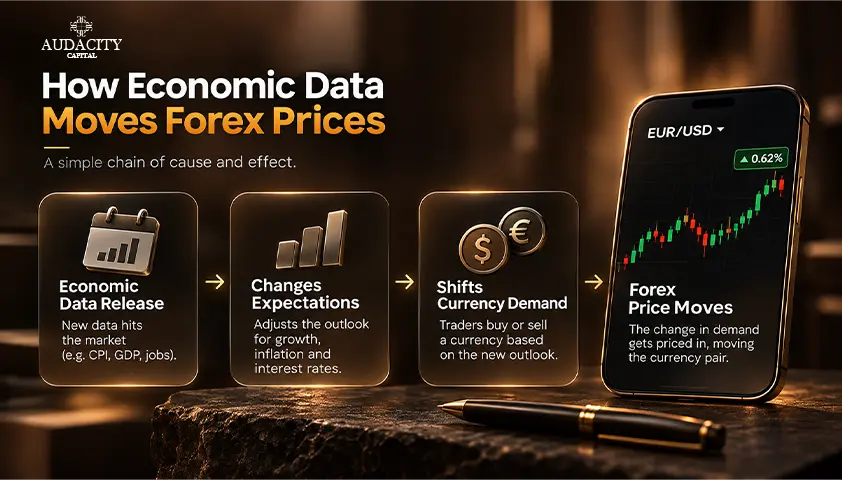
Imagine it as a chain reaction. The economic outlook evolves in response to economic information. This could prompt the traders to change their outlook on monetary policy, interest rates and bond yields. Those changes may affect the demand of a currency.
Let's take a look at a simple example. Suppose that the inflation rates in the U.S. are higher than what the analysts predicted them to be. Traders start to expect that the Federal Reserve will keep interest rates high for a longer time or postpone interest rate cuts.
A higher expected interest rate makes the US dollar more attractive as an investment, hence the demand for the dollar increases. The movement of the currency depends on how much the market expected, how much it was priced in and by what concerns the central bank.
High-Impact Economic Indicators Forex Traders Watch
If you look for an economic indicator list, you'll discover dozens of releases. It is not necessary to learn every one of them. It's simpler to categorize key economic indicators based on what they tell to you:
Indicator Group | Key Releases | What Traders Learn |
Monetary Policy | Interest-rate decisions, central-bank statements | Direction of interest rates and policy |
Inflation | CPI, PCE, PPI | Price pressures and potential policy response |
Employment | Unemployment, wage growth, NFP | The strength of the labor market and inflation pressure |
Economic Growth | The state of the economy, whether it is growing or declining | |
Business Activity | PMI, ISM | Changes in manufacturing and services activity |
Consumer Activity | Retail sales, confidence | Strength of household demand |
Production & Trade | Industrial production, trade balance | Production conditions and international trade flows |
What economic indicators matter most for traders? The answer to this question would depend on the current economic situation and the concerns of central banks.
If there is increasing inflation, then CPI and PCE statistics will become more important for the traders since they can affect interest-rate decisions.
In case there are indications that the economy is weakening, then employment statistics, such as NFP and the unemployment rate, would become more important.
When the economy is weak, then GDP and PMI statistics can be useful sources of information about the economy.
Another method of understanding indicators is to consider when they are signaling a change in the economic activity. This facilitates their categorization into leading, lagging and coincident indicators.
Leading vs Lagging Economic Indicators in Forex
Leading Economic Indicators
Leading indicators provide information on the economy's performance in the coming months and years, even before it is reflected in other measures of economic growth, such as GDP.
They can be PMI or ISM surveys, consumer confidence, business confidence and building permits/housing activity (if applicable). FX traders are interested in this, because these releases can provide clues as to a big change at an early stage.
For example, businesses might be beginning to feel weaker, but GDP hasn't yet turned negative, so the PMI numbers may be warning us. Remember, these are indications, not absolute facts.
Lagging Economic Indicators
Lagging indicators reflect the trend that has already occurred. The unemployment rate, wage growth and inflation indicators like CPI all tend to lag the economy.
Lagging doesn’t mean it's unimportant. Because inflation is the confirmation of price increases, central banks will still move rapidly when they surprise investors, leading to a sharp currency move.
What About Coincident Indicators?
Coincident indicators move with the economy and show what is happening right now. Common examples include retail sales, industrial production and Non-Farm Payrolls (NFP).
NFP is an indication of the number of jobs created in the latest month and is therefore a current indicator of the state of the labor market. Then traders assess that snapshot to determine its implications for consumer spending, inflation and the next move by the central bank.
Regardless of when they signal economic changes, traders often focus on three key areas when assessing a currency: inflation, employment and economic growth.
How Inflation, Employment and Growth Data Impact Forex
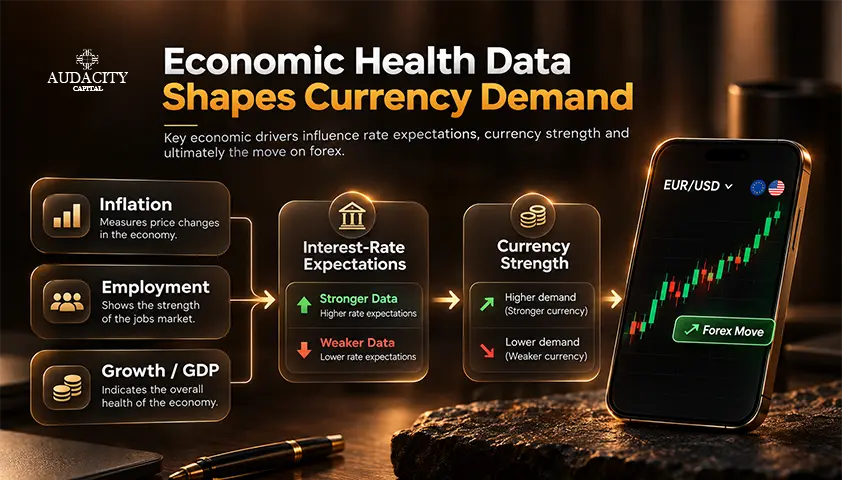
Each economic release offers a different facet of economic information. Comparing them side by side can give traders an idea of larger inflation, jobs and growth trends.
Inflation Data and Forex
The main inflation numbers are the Consumer Price Index (CPI), core CPI (excluding food and energy), Personal Consumption Expenditures (PCE) index, core PCE and, lastly, the Producer Price Index (PPI) that reflects changes in wholesale prices and provides an insight into future consumer prices.
In general, they signal the rate of inflation and the amount of pressure the central bank is under. PCE gets special attention in the U.S. because it’s the Fed’s preferred inflation gauge.
If inflation shoots up unexpectedly, traders might begin to anticipate higher interest rates, fewer rate cuts or more restrictive policy. When it comes in low the reverse applies.
Employment Data and Forex
The labor market is significant because it impacts spending and spending is what makes the economy work. The key statistics are Non-Farm Payrolls (NFP), the unemployment rate and wages growth.
A strong NFP report shows the labor market is currently healthy. Traders then ask what that implies for consumer spending, wage pressure, and inflation, and therefore for interest rates.
A weak report points to a cooling economy and raises the odds of rate cuts. Because the unemployment rate and wage growth are lagging indicators, they tend to confirm or contradict what the payrolls number suggested, so traders read the whole report rather than the NFP headline alone.
A strong payrolls figure can still disappoint if unemployment rises, wage growth slows, or previous months are revised down. In that case the market may read the report as a weakening labor market and price in a higher chance of rate cuts, and the dollar can fall even though the headline beat forecasts.
Economic Growth and Business Activity
Each growth indicator has different uses.
GDP is the best comprehensive measure of economic growth. PMI and ISM indexes provide a more current indicator of business conditions in manufacturing and services industries.
Retail sales data measures household spending, whereas industrial production measures production in the manufacturing, mining and utilities industries.
All of them impact growth expectations. Stronger economic growth may increase expectations that interest rates will remain higher, while weaker growth may lead traders to anticipate rate cuts. These expectations can influence currency demand.
However, understanding what an indicator measures is only part of the process. Traders also need to compare each release with market expectations to understand its potential impact.
Actual vs Forecast vs Previous: Why Expectations Matter
In every economic release you will see three figures in a line. The actual figure is the one just released. Forecast is the figure economists and analysts expect before the release. Previous is the number from the previous release period.
Let's take a hypothetical example with CPI:
Previous | Forecast | Actual |
3.0% | 3.1% | 3.5% |
The actual figure of 3.5% is higher than the previous figure, but what really matters is the gap between the actual figure of 3.5% and the forecasted 3.1%.
This difference is called economic surprise and may require fast revision of the interest rate expectations and cause a significant currency movement.
The previous figure is also important since it may be adjusted. If the job gains in the previous month are revised significantly down, the good news of a strong jobs report can feel underwhelming.
To sum up, it is the difference between expectation and reality that has a huge impact on the market, rather than the actual number.
Here's what happened in the CPI market
On November 10, 2026, the BLS indicated that the CPI had increased by 0.4% in October after a 0.6% rise in the month of September. The consensus forecast was for a lower increase of 0.3% as per the sources from Reuters.
Meanwhile, the core consumer price index increased by 0.3% in the month as it does not take into account food and energy.
The October inflation report did not have an inflation figure for the year to date since the BLS couldn't get data for October 2025 due to the federal government shutdown. The monthly figures still showed that inflation was running hotter than expected.
The better-than-expected inflation data helped to reinforce the view that the Fed might hike interest rates in December.
The US Dollar was higher after the report along with the treasury yields. This demonstrates how a surprise inflation figure may impact demand for the currency.
Another Example: Employment Report and the US Dollar
The same principle can be applied to employment reports. On August 2, 2024, the US economy created much less jobs than forecasted by the experts, and unemployment rose to 4.3%.
Traders immediately started to increase expectations for the rate cuts by the US Federal Reserve, as lower interest rates were now expected. As a result, the dollar went down, with pairs like USD/JPY being the most affected.
A slow jobs report caused a shift in perceptions with regard to policy, and consequently, there was a shift in the price of the currency.
Why Strong Economic Data Does Not Always Strengthen a Currency
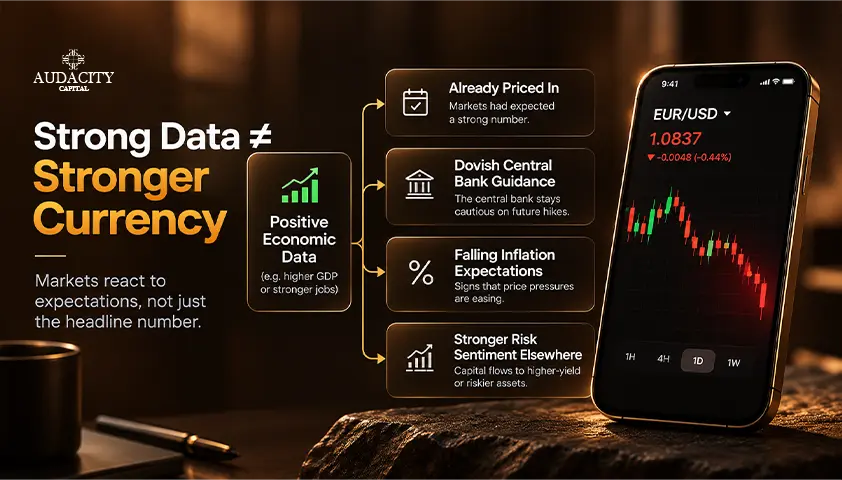
That's where most of the people who start off go wrong. If it's a good economy, why shouldn't the currency rise? Not necessarily, and here are a few reasons.
The result was already priced in.
If traders are looking for strong data, the currency could have been going up for the days leading up to the report, so there would not be much room to move.
The market was hoping for an even better result.
A positive number can still let you down. GDP can rise substantially but as long as it remains below consensus expectations, the currency can weaken.
Other parts of the release were weak.
A strong NFP headline can be overshadowed by rising unemployment, slowing wage growth, or downward revisions, as covered in the employment section above. The headline looks strong, but the details tell a different story.
Central-bank priorities have changed.
If the main concern of the central bank is inflation, then CPI could be more relevant than GDP. In times of increasing recession risks, employment and growth data can take over.
Market positioning can affect the reaction.
If the trade is already in play and good news is released, it may have little effect on moving the price further, or good news could lead to a reversal as traders take profits. Learning how to read market sentiment will help you spot when positioning is stretched.
The lesson is that economic indicators do not create automatic forex reactions. They are one of the important inputs and it is logical to use fundamental and technical analysis together as using one number alone is not very useful.
To assess these factors before a release, traders also need to know when important economic data is scheduled and what the market expects.
How Traders Track High-Impact Economic Releases
The majority of traders use an economic calendar to monitor the scheduled releases. An economic calendar is simply a list of upcoming data releases and events.
It typically displays the date and release time, country, indicator, previous result, forecast, actual result (after publication), and the level of market impact expected.
The economic calendar is especially useful for the release of major data such as CPI, NFP, GDP and central bank decisions because the release of this data tends to bring more volatility.
If you know when it is expected, it will not come as a shock to you. Some releases will impact some currency pairs more than others; find out which currencies are affected by the release before trading around it.


Audacity Capital Empowering Traders Since 2012
Join the Prop FirmConclusion
The economic indicators give you an insight into changes in inflation, employment, growth, consumer demand, business activity and monetary policy.
It is important to compare the actual data of each release with the expectations, previous readings, revisions, central bank concerns and market sentiment before reacting to the news.
Forex economic indicators are most effectively interpreted as signals concerning the changing economic and monetary-policy outlook, and once that outlook changes, currencies reprice.
FAQs
Traders tend to be most interested in economic data on inflation (CPI, PCE), employment (NFP), GDP, PMI and other business-activity readouts, and central-bank interest-rate decisions. Each reveals a facet of the economy, and when combined, they can assist traders in making estimates of the direction of monetary policy and currency demand.
There are no definitive answers. The most crucial indicator varies depending on the economic situation and central-bank agendas. If inflation is the primary concern, then CPI might take precedence. If it's about growth or jobs, employment and GDP figures can often take center stage.
Leading indicators, like PMI, business confidence and consumer confidence, offer early indications about where the economy is headed. Traders keep an eye on them to spot possible changes in growth before it becomes apparent through other indicators, such as GDP.
Lagging indicators confirm trends that have already taken place. Common examples are the unemployment rate, wage growth, and inflation measures such as CPI. They are not unimportant, because central banks often respond to them and they can still move currencies sharply, especially when the data surprises the market.
CPI is the consumer price inflation indicator. If the reading comes out higher than expected, then traders might be looking at a higher interest rate or slow rate cuts, which may help support the currency. If the reading comes out lower, then it will be the opposite expectation that prevails. It all depends on changes in policy expectations.
NFP tells you how many jobs the US economy created and gives you an immediate idea about the labor market's strength. Employment influences consumer spending and inflation and thus expectations about Fed policies influence US dollars and other currencies.
GDP is the indicator of the rate of economic growth. It may influence the view on the monetary policy and the investment environment and thus demand for currency. As any other indicator, the market reacts depending on how the results of the indicator compare to expectations and previous positioning.
No. Economic indicators can be used to assess the economic situation and help traders form their economic expectations, but they cannot be relied upon to predict the movement of the currency. The market responds to surprises, positioning, and priorities of central banks and thus indicators should be used as one of the tools.

Ready to apply disciplined risk to crypto? Explore Audacity Capital's new crypto instruments and bring your trading strategy.
Learn MoreNewsletter
Join our newsletter to stay up to date on features and releases.
Join Our Social & Community

Start Your Journey Today With Our Free Trial
Proudly showcase your skills and accomplishments through certificates and get recognition for your hard work and dedication from potential investors and peers.
Free TrialRelated Articles

Why Ex Military Are Good Traders?
Discover the new career opportunity for ex-military: trading. Banks and trading firms are hiring veterans for the trading floor.


Candlestick Patterns: How Traders Read Price Action on a Chart
Learn to read price action with proven candlestick strategies and improve trading consistency now with Audacity

Best Forex Technical Analysis Books
Find the perfect book for technical analysis in currency trading. Learn from experts and gain a competitive edge in the forex market.

Is Crypto Less Risky?